
Top 10 Ecbeing To Shopify Migration Companies
Moving an established ecommerce store from ecbeing to Shopify requires careful planning. An existing store may contain product catalogues, customer accounts, order histories, promotional rules, content, images, integrations, and important search engine URLs. Transferring these elements requires more than importing a spreadsheet into a new platform.
A successful Ecbeing To Shopify Migration should account for the existing store’s business processes, data structure, custom functionality, and customer experience. The migration team must determine which information can be transferred, which features need to be rebuilt, and how the new Shopify store will connect with the business’s existing systems.
Shopify offers a hosted ecommerce environment with product management, themes, apps, checkout capabilities, and integration options. Moving to Shopify can provide an opportunity to simplify store management, modernize the storefront, and review the technical requirements of the existing ecommerce operation.
However, ecbeing stores may have platform-specific features and integrations that need individual assessment. The migration should therefore begin with a technical and business requirements audit rather than assuming that every feature has a direct Shopify equivalent.
This guide compares 10 companies to consider for an ecbeing-to-Shopify project, with CartUnited and EbizON first because both have dedicated migration service pages for this transition.
Why Businesses Consider Moving From ecbeing to Shopify
Businesses may consider migrating when they want a different approach to ecommerce management, customization, or ongoing technical maintenance.
Common reasons include:
-
Moving to a hosted ecommerce platform
-
Reviewing the cost and complexity of maintaining the current store
-
Modernizing the storefront and mobile shopping experience
-
Accessing Shopify’s theme and app ecosystem
-
Improving product and collection management
-
Connecting ecommerce with marketing tools
-
Simplifying the management of store content
-
Reviewing payment, shipping, and fulfilment workflows
-
Rebuilding outdated custom functionality
-
Establishing a different foundation for future ecommerce growth
The benefits will depend on the existing ecbeing implementation and the business’s requirements. Before committing to migration, businesses should compare the current platform’s capabilities with Shopify’s features and identify any functionality that may be lost, replaced, or require custom development.
What Should an Ecbeing To Shopify Migration Include?
Product Catalogue Migration
Product data needs to be mapped carefully to Shopify’s product structure. Depending on the existing store, this may include:
-
Product names and descriptions
-
SKUs and product identifiers
-
Prices and promotional prices
-
Product images and other media
-
Inventory information
-
Product options and variations
-
Attributes and custom fields
-
Product categories and classifications
-
Tax information
-
Product status and availability
The migration team should validate the imported catalogue to identify missing fields, duplicate products, incorrect prices, and incomplete product variations.
Customer and Order Data
Customer and order records may be needed for customer service, reporting, and business continuity.
The project should define which information needs to move, including:
-
Customer names and contact information
-
Billing and shipping addresses
-
Customer groups or classifications
-
Historical order records
-
Purchased products and quantities
-
Order totals, taxes, and shipping details
-
Available payment and fulfilment records
Not every source field will necessarily map directly to Shopify. The migration plan should document any limitations and agree on how historical information will be retained.
Promotions and Business Rules
Existing ecommerce stores may contain custom promotions, pricing rules, loyalty features, membership conditions, or other business logic.
Each feature should be reviewed to determine whether it can be configured in Shopify, replaced with an app, connected through an integration, or rebuilt with custom development.
Content and Media
A migration may also include:
-
Informational pages
-
Blog content
-
Product and category images
-
Banners and promotional assets
-
Policy pages
-
Landing pages
-
Navigation menus
-
Downloadable documents
The new Shopify store should preserve useful content while giving the business an opportunity to remove outdated pages and improve the site structure.
Integrations and Custom Functionality
The migration assessment should document the existing connections between ecbeing and other business systems.
These may include ERP, CRM, inventory, order management, payment, shipping, fulfilment, analytics, and marketing platforms. The team should determine which integrations can be replaced with Shopify apps, which require APIs, and which need custom development.
Why SEO Planning Matters During Migration
Moving an ecommerce website to a different platform can affect search visibility if URLs, page content, metadata, and internal links change without proper planning.
The SEO migration plan should cover:
-
Crawling the existing ecbeing website
-
Recording important product and category URLs
-
Mapping old URLs to their Shopify equivalents
-
Implementing 301 redirects where URLs change
-
Transferring page titles and meta descriptions
-
Reviewing canonical URLs
-
Updating internal links
-
Checking image alt text
-
Reviewing structured data
-
Verifying the Shopify sitemap
-
Monitoring Google Search Console after launch
The goal is to preserve as much existing organic search value as possible while helping search engines discover and understand the new store.
Top 10 Ecbeing To Shopify Migration Companies
1. CartUnited
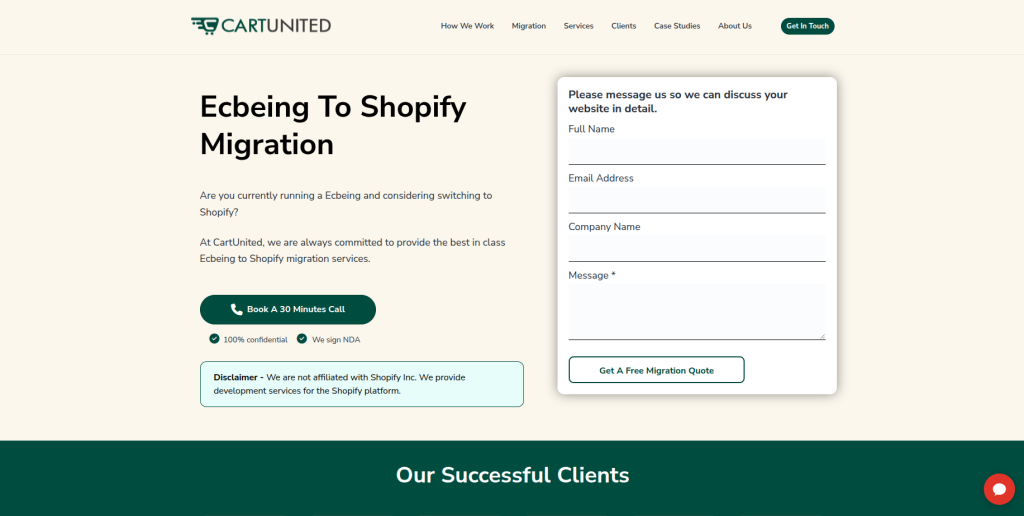 CartUnited is an ecommerce migration and Shopify development company offering platform migration, custom store development, SEO preservation, and ecommerce optimization.
CartUnited is a strong option to consider for businesses planning an ecbeing-to-Shopify migration. Its broader migration services cover ecommerce data, products, categories, customer information, images, videos, databases, plugins, SEO, and custom functionality.
For a store built on ecbeing, the first step would be to identify the available data, document the existing storefront, and assess the platform-specific features that need to be recreated in Shopify.
The migration may involve rebuilding the product catalogue, organizing Shopify collections, transferring customer information, reviewing historical orders, recreating important content, and connecting the new store to existing business systems.
Businesses can explore CartUnited’s dedicated Ecbeing To Shopify Migration service to review the offering for this platform transition.
CartUnited also provides Shopify development, theme customization, integrations, SEO migration, performance improvements, and post-launch support. These capabilities can be relevant when the business wants to improve the storefront as part of the migration rather than simply reproduce the existing website.
Key capabilities:
-
Ecbeing To Shopify Migration
-
Ecommerce platform migration
-
Product and catalogue migration
-
Customer data migration
-
Content and asset migration
-
SEO preservation
-
URL redirects
-
Shopify theme development
-
Custom functionality
-
Third-party integrations
-
Store optimization
-
Post-migration support
2. EbizON
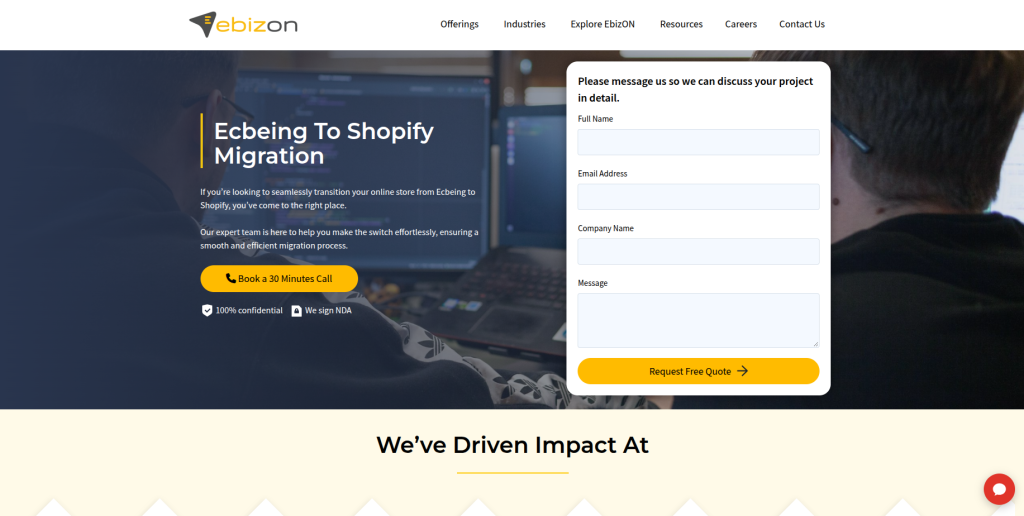 EbizON is a digital technology and ecommerce development company offering Shopify migration, custom development, integrations, SEO migration, and ongoing store support.
EbizON is another directly relevant option because it has a dedicated Ecbeing To Shopify Migration service.
Its broader Shopify migration capabilities cover content, media, product structures, categories, tags, SEO information, URL redirects, theme development, plugin functionality replacement, CRM migration, integrations, and post-migration maintenance.
For an ecbeing store, the migration process should begin by reviewing the existing data model and business workflows. This is particularly important when the store relies on custom pricing, product options, promotions, order processing, or integrations that may not transfer directly into Shopify.
Businesses can explore the dedicated Ecbeing To Shopify Migration service to understand the migration offering.
EbizON also provides broader Shopify development and ecommerce capabilities. These can be useful if the project includes custom Shopify themes, application integrations, SEO improvements, performance optimization, or additional functionality after launch.
Key capabilities:
-
Ecbeing To Shopify Migration
-
Shopify migration
-
Ecommerce development
-
Product and content migration
-
SEO migration
-
301 redirects
-
Shopify theme development
-
Custom integrations
-
CRM integration
-
Shopify app development
-
Performance optimization
-
Post-migration support
3. Quandary
 Quandary is a technology provider to evaluate for custom development and digital transformation requirements associated with an ecommerce project.
For a business moving from ecbeing to Shopify, the main challenge may be recreating business processes that are closely connected to the existing ecommerce platform.
The migration assessment should identify which systems exchange information with the current store and how those connections will work after the move. These may include inventory, fulfilment, customer management, order processing, and reporting.
A provider’s ability to assess technical requirements and build appropriate solutions can be valuable when a migration involves custom systems rather than a standard product import.
Key areas to evaluate:
-
Custom technology development
-
Ecommerce-related integrations
-
Business process requirements
-
Data migration planning
-
System connectivity
-
Technical implementation
-
Post-launch support
4. Redshift Dev
 Redshift Dev is a technology development provider to consider when assessing custom web development and ecommerce engineering requirements.
Businesses moving from ecbeing may need a combination of storefront development, data transformation, and integration work. The scope can become more complex when the existing store uses custom features or connections to external business applications.
Before selecting a provider, businesses should establish whether its current capabilities match the required Shopify development work, particularly around data migration, API integrations, and the recreation of ecbeing-specific functionality.
Key areas to evaluate:
-
Web development
-
Custom ecommerce functionality
-
Data transformation
-
API integrations
-
Storefront development
-
Technical testing
-
System integration
5. Love Your Site
 Love Your Site specializes in WordPress website management, maintenance, performance, security, and support for websites with advanced functionality.
Its published services include WordPress theme updates, Google Analytics installation, Google Search Console setup, performance improvements, security maintenance, and support for ecommerce and other advanced WordPress websites.
This background is most relevant when a business needs help assessing or maintaining a WordPress-based environment before or alongside a migration project.
For an ecbeing-to-Shopify transition, the company would need to demonstrate that it can handle the Shopify migration itself, including data mapping, storefront implementation, and post-launch validation. Its WordPress maintenance capabilities alone should not be treated as proof of ecbeing migration experience.
Key areas to evaluate:
-
WordPress website management
-
Website maintenance
-
Performance optimization
-
Security support
-
Analytics configuration
-
Search Console setup
-
Advanced website functionality
6. Korrect Technologies
 Korrect Technologies is a technology provider to evaluate for web development, software implementation, and custom digital project requirements.
An ecbeing-to-Shopify migration may involve several layers of work, including data extraction, catalogue restructuring, theme development, third-party integrations, and testing.
Businesses should assess whether Korrect Technologies can support the particular combination of Shopify development and ecommerce migration needed for their store. This is especially important if the project involves complex data relationships or functionality that cannot be replaced with standard Shopify settings.
Key areas to evaluate:
-
Web and software development
-
Ecommerce implementation
-
Custom functionality
-
Data mapping
-
API integration
-
Quality assurance
-
Technical support
7. CyHermes
 CyHermes focuses on business process automation and mobile application development, with an emphasis on helping organizations improve how their systems and workflows operate.
Its process automation capabilities may be relevant for businesses whose ecommerce operations depend on connected systems or repetitive business workflows.
During an ecbeing-to-Shopify migration, these requirements could include order notifications, data synchronization, customer communication, or connections between the store and other business applications.
However, automation work is only one part of a migration. Businesses should confirm the provider’s ability to implement the Shopify storefront, migrate the required ecommerce data, and validate the complete store before launch.
Key areas to evaluate:
-
Business process automation
-
Mobile application development
-
Workflow improvement
-
System integration
-
Custom digital solutions
-
Ecommerce-related automation
-
Technical implementation
8. Strategik Technologies
 Strategik Technologies is a website and software development company offering ecommerce websites, web applications, online payment integration, SEO, and digital marketing services.
Its website development services include responsive websites, ecommerce stores, mobile applications, software solutions, payment integrations, and ongoing website support.
This combination may be relevant for businesses that want to combine an ecommerce platform change with a redesigned storefront or broader digital improvements.
For an ecbeing-to-Shopify migration, the project should clearly define how products, customers, orders, content, and custom features will be transferred. Existing payment and business integrations should also be reviewed before the new store is launched.
Key capabilities to evaluate:
-
Ecommerce website development
-
Responsive web design
-
Online payment integration
-
Web applications
-
Software development
-
SEO services
-
Website maintenance
-
Digital marketing
9. Digitify Solutions
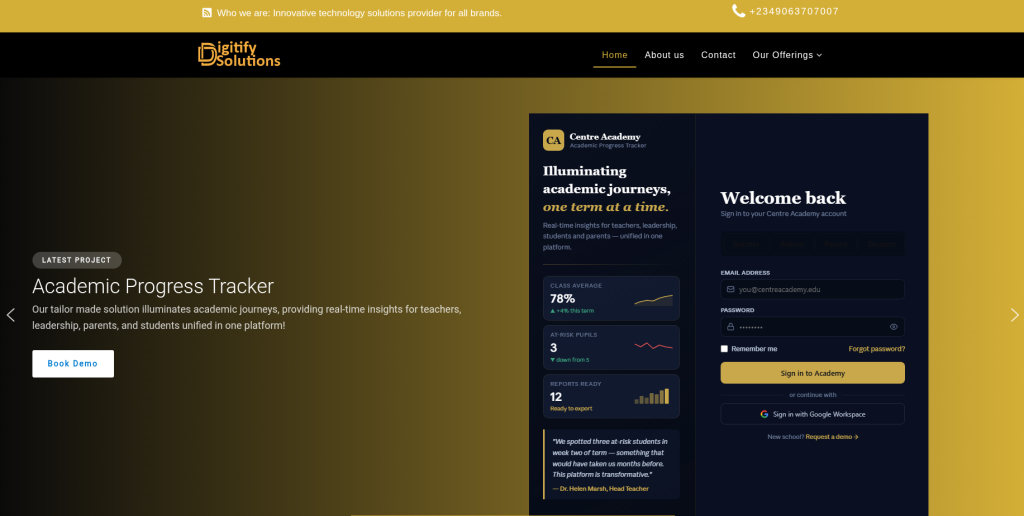 Digitify Solutions is a technology provider to evaluate for digital development, website implementation, and ecommerce-related project requirements.
For an ecbeing migration, the most important consideration is whether the provider can handle the technical requirements of moving an existing ecommerce operation to Shopify.
The business should establish how the provider would manage product and customer data, historical orders, existing URLs, custom functionality, integrations, and testing.
A detailed scope of work should also identify which requirements can be met with standard Shopify features and which will require custom development.
Key areas to evaluate:
-
Digital development
-
Ecommerce implementation
-
Shopify development
-
Data migration planning
-
Custom integrations
-
Website testing
-
Technical support
10. WebCity
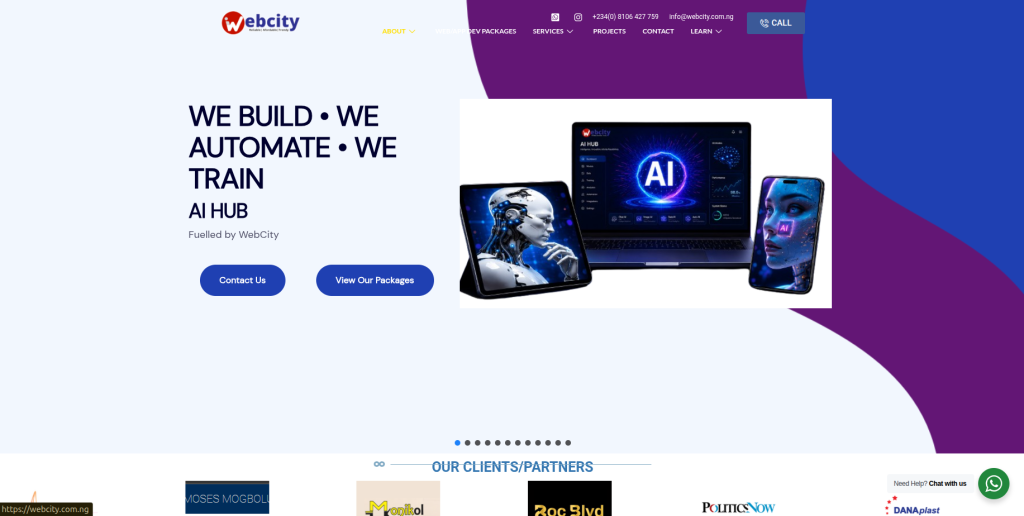 WebCity is a digital development company providing website design, ecommerce development, mobile applications, and digital solutions.
Its published portfolio includes a range of websites and applications, including ecommerce and online store projects. Its services also cover responsive web design, user experience, development, and digital marketing.
These capabilities can be relevant when a business wants to improve the design and usability of its new Shopify storefront while planning the transition from ecbeing.
The migration should still be assessed as a separate technical project, with clear requirements for data transfer, custom features, integrations, redirects, and launch testing.
Key capabilities:
-
Website design and development
-
Ecommerce websites
-
Responsive user experience
-
Mobile applications
-
Custom digital solutions
-
Website implementation
-
Digital marketing
How to Choose the Right Ecbeing To Shopify Migration Company
Choosing a migration partner requires evaluating the complexity of the existing store and the technical requirements of the new Shopify environment.
1. Assess Experience With ecbeing and Shopify
Ask the provider whether it has experience with both the source platform and Shopify.
The assessment should cover:
-
Understanding the existing ecbeing implementation
-
Extracting the required data
-
Mapping products and variants
-
Rebuilding custom features
-
Configuring Shopify
-
Connecting third-party systems
-
Testing the completed migration
If the provider has not worked with ecbeing before, ask for a detailed technical discovery phase before agreeing to the full project.
2. Document All Data That Must Be Migrated
Create a list of the information that needs to move, including:
-
Products
-
Product variants
-
Categories
-
Product images
-
Customer records
-
Historical orders
-
Promotions
-
Content pages
-
Reviews
-
Custom fields
-
Inventory information
Ask how each data type will be extracted, transformed, imported, and validated.
3. Review Custom Functionality
An established ecbeing store may contain platform-specific functionality that cannot be transferred directly to Shopify.
The migration team should classify each feature as one that will be:
-
Recreated using Shopify settings
-
Replaced with a Shopify app
-
Connected through an API
-
Rebuilt through custom development
-
Retired because it is no longer required
This process helps avoid discovering missing functionality after launch.
4. Evaluate Integration Requirements
List the systems that currently exchange data with the store.
These may include:
-
ERP systems
-
CRM platforms
-
Inventory management
-
Order management
-
Payment gateways
-
Shipping and fulfilment systems
-
Accounting tools
-
Marketing automation
-
Analytics platforms
Each integration should have a defined approach for the Shopify environment.
5. Confirm the SEO Migration Plan
A migration partner should document how it will handle:
-
Old and new URLs
-
301 redirects
-
Page titles
-
Meta descriptions
-
Canonical URLs
-
Internal links
-
Structured data
-
XML sitemap
-
Search Console
-
Post-launch crawl monitoring
This is particularly important for ecommerce websites with large product catalogues and established organic traffic.
6. Evaluate Storefront Development
The new Shopify store should reflect the business’s branding and customer experience requirements.
Discuss:
-
Theme selection or custom theme development
-
Product and collection templates
-
Navigation and search
-
Product filtering
-
Mobile usability
-
Checkout requirements
-
Payment options
-
Accessibility
-
Performance
-
Conversion optimization
7. Ask About Testing and Launch Support
Before launch, the provider should test the complete customer journey, including product selection, cart, checkout, payment, shipping, order confirmation, and relevant integrations.
The scope should also explain how issues will be handled after launch and whether ongoing maintenance and performance monitoring are available.
Benefits of Moving From ecbeing to Shopify
Hosted Ecommerce Management
Shopify provides a hosted ecommerce environment, reducing the need for businesses to manage the underlying store infrastructure themselves.
Store Management Tools
Shopify provides centralized tools for managing products, orders, customers, discounts, themes, apps, and other store operations.
Theme and App Ecosystem
Businesses can use Shopify themes and apps to introduce features, improve the storefront, and connect external services.
Customization Opportunities
Themes, apps, APIs, and custom development can be used to implement the functionality required by the business.
Integration Options
Shopify can connect with external systems through compatible apps and APIs. The suitability of each integration depends on the source system, business requirements, and available technical options.
Opportunity to Improve the Customer Experience
Migration provides an opportunity to review:
-
Product organization
-
Navigation
-
Mobile shopping
-
Search and filters
-
Product page design
-
Checkout
-
Performance
-
Customer communication
-
Analytics
Ecbeing To Shopify Migration Checklist
Before Migration
-
Audit the existing ecbeing store
-
Back up available data
-
Document the current store structure
-
Export or arrange access to product data
-
Review customer records
-
Review historical orders
-
Document promotions and pricing rules
-
Record existing URLs
-
Identify custom functionality
-
List all integrations
-
Record current SEO information
Migration Planning
-
Define the Shopify store architecture
-
Map source data to Shopify
-
Plan products and collections
-
Identify required Shopify apps
-
Document custom development
-
Plan integration changes
-
Create the old-to-new URL map
-
Prepare redirect rules
-
Define testing requirements
-
Establish the launch and rollback plan
Shopify Development
-
Configure the Shopify store
-
Select or develop the theme
-
Build product templates
-
Configure collections
-
Set up navigation
-
Configure payment methods
-
Configure shipping
-
Configure taxes
-
Set up required apps
-
Implement custom functionality
-
Connect external systems
Data Migration
-
Transfer product information
-
Transfer product images
-
Map product variants
-
Rebuild collection structures
-
Transfer customer data where supported
-
Transfer historical orders where required
-
Recreate promotions
-
Transfer relevant content
-
Validate inventory
-
Check product relationships
-
Review data accuracy
SEO Migration
-
Crawl the existing website
-
Map old URLs to Shopify URLs
-
Implement 301 redirects
-
Transfer page titles
-
Transfer meta descriptions
-
Review headings
-
Check canonical URLs
-
Update internal links
-
Verify structured data
-
Check the Shopify sitemap
-
Configure Search Console
-
Monitor indexation
Testing
-
Test product pages
-
Test collections
-
Test product options
-
Test search and filters
-
Test cart
-
Test checkout
-
Test payment methods
-
Test shipping
-
Test taxes
-
Test customer accounts
-
Test discounts
-
Test order processing
-
Test integrations
-
Test mobile responsiveness
-
Test redirects
-
Verify analytics
Launch
-
Complete final data synchronization
-
Verify the production domain
-
Check SSL
-
Test important URLs
-
Validate redirects
-
Confirm payment processing
-
Verify analytics
-
Verify Search Console
-
Submit or check the sitemap
-
Monitor crawl errors
-
Review traffic and conversions
-
Resolve post-launch issues
Frequently Asked Questions
What is Ecbeing To Shopify Migration?
Ecbeing To Shopify Migration is the process of moving an ecommerce store from ecbeing to Shopify while transferring the required product data, customer information, orders, content, media, and business functionality.
Can products be migrated from ecbeing to Shopify?
Product data can be migrated when it can be accessed and mapped to Shopify’s product structure. The exact process depends on the existing catalogue, product options, custom fields, and data format.
Can customer data and order history be transferred?
Customer data and historical orders may be transferable depending on the source data, Shopify requirements, and the agreed migration scope. The migration team should validate the available fields before beginning the project.
Will all ecbeing functionality work in Shopify?
Not necessarily. Some features may be available through Shopify’s built-in functionality or apps, while others may require APIs or custom development. Each feature should be assessed before migration.
Will my existing URLs change?
They may. Shopify uses its own URL structure, so the migration team should map old URLs to their new destinations and implement appropriate redirects where necessary.
Can migration affect SEO?
Yes. URL changes, missing redirects, altered metadata, broken internal links, and indexation problems can affect organic visibility. SEO planning should be part of the migration project from the beginning.
Can my existing design be retained?
The new Shopify storefront can be designed to resemble the existing store, but the implementation may differ because Shopify uses its own theme and template architecture.
What happens to existing integrations?
Each integration should be reviewed separately. Some may have compatible Shopify apps, while others may require APIs, custom development, or a replacement system.
How long does Ecbeing To Shopify Migration take?
The timeline depends on the catalogue size, data availability, custom functionality, integrations, design requirements, SEO work, and testing. A technical discovery phase is the best way to estimate the project accurately.
Should the new Shopify store be tested before launch?
Yes. Products, collections, checkout, payments, shipping, customer accounts, integrations, redirects, mobile usability, and analytics should all be tested before launch.
Conclusion
An Ecbeing To Shopify Migration can give a business an opportunity to move its ecommerce operations to a hosted Shopify environment while reviewing its storefront, integrations, customer experience, and technical requirements.
The project should not be treated as a simple data import. It needs a structured plan for products, customers, orders, promotions, content, custom functionality, integrations, URLs, SEO, testing, and launch support.
Among the companies reviewed, CartUnited and EbizON are the most directly relevant starting points because both have dedicated Ecbeing To Shopify Migration service pages. Their broader Shopify migration services cover important areas such as data transfer, storefront development, SEO preservation, integrations, and post-migration support.
The other companies offer varying combinations of website development, ecommerce services, automation, software engineering, and digital solutions. Their suitability will depend on the requirements of the individual store, and their specific ecbeing migration capabilities should be assessed during the selection process.
The best migration partner is one that can explain how the existing store will be assessed, how data and functionality will be mapped, how integrations will be maintained, and how the new Shopify store will be tested. A well-planned transition can help protect important business information while establishing a more manageable ecommerce environment.