
Top 10 MijoShop to Shopify Migration Companies
Moving an established ecommerce store from MijoShop to Shopify is a significant technology change. It involves more than transferring products from one platform to another. Businesses also need to consider customers, orders, product variations, images, categories, content, URLs, SEO settings, integrations, and the overall shopping experience.
A well-planned MijoShop To Shopify Migration can give businesses access to Shopify’s hosted ecommerce environment while providing an opportunity to modernize the storefront, improve usability, simplify store management, and review existing integrations.
However, migration should be planned carefully. Data needs to be mapped correctly, important URLs should be preserved or redirected, and the new Shopify store should be tested before launch.
This guide covers 10 companies that businesses can consider when planning a MijoShop to Shopify migration.
Why Businesses Move From MijoShop to Shopify
MijoShop has been used by businesses that need ecommerce functionality within a Joomla-based environment. As ecommerce requirements evolve, some businesses may prefer moving to a hosted platform such as Shopify.
Common reasons for considering the migration include:
- Moving to a hosted ecommerce platform
- Simplifying technical maintenance
- Improving store management
- Accessing Shopify’s ecommerce ecosystem
- Reducing dependence on server-side maintenance
- Improving the mobile shopping experience
- Connecting the store with Shopify apps
- Modernizing the storefront
- Supporting future ecommerce growth
- Integrating marketing and sales tools
Shopify is a hosted ecommerce platform designed around online store management, product catalogues, checkout, payments, apps, themes, and ecommerce operations.
For businesses considering the technical differences between ecommerce platforms, resources about Shopify, Joomla, and e-commerce can provide useful background.
What Does a MijoShop to Shopify Migration Involve?
A successful migration should cover the complete store rather than focusing only on products.
Product Migration
Product information can include:
- Product names
- Product descriptions
- Product images
- SKUs
- Prices
- Inventory
- Product variations
- Attributes
- Custom fields
- Tax information
- Downloadable products
The source data should be reviewed and mapped to Shopify’s product and variant structure before the migration begins.
Category and Collection Migration
The existing MijoShop category structure should be analyzed before rebuilding the store.
The migration may involve:
- Product categories
- Subcategories
- Product tags
- Collections
- Category images
- Navigation menus
- Product filtering
Shopify uses collections and product organization differently from MijoShop, so the store structure may need to be redesigned rather than copied exactly.
Customer Migration
Customer records can include:
- Names
- Email addresses
- Phone numbers
- Addresses
- Customer groups
- Account information
- Historical customer information
The migration team should determine which customer information can be transferred and how it should be mapped to Shopify.
Order Migration
Historical order information can be important for customer support, accounting, reporting, and business records.
Depending on the project requirements, migration may include:
- Order numbers
- Customer details
- Products purchased
- Quantities
- Order totals
- Taxes
- Shipping information
- Order statuses
- Historical order records
Content and Media Migration
The migration can also involve:
- Website pages
- Blog content
- Images
- Banners
- Documents
- Product media
- Policy pages
- Landing pages
Businesses should decide which content should be migrated as-is and which content should be redesigned for the Shopify store.
Why SEO Should Be Part of the Migration Plan
Changing ecommerce platforms can affect organic visibility if URLs, metadata, content structures, internal links, or indexation settings are changed without proper planning.
An SEO migration plan should include:
- Existing URL crawling
- URL mapping
- 301 redirects
- Meta titles
- Meta descriptions
- Heading structure
- Canonical URLs
- Internal links
- XML sitemap
- Robots.txt
- Image optimization
- Structured data
- Google Search Console monitoring
The goal is to make the transition from the old MijoShop URLs to the new Shopify URLs as clear as possible.
SEO should also be reviewed after launch because search engines may take time to process the new website structure.
Top 10 MijoShop to Shopify Migration Companies
1. CartUnited
CartUnited is an ecommerce migration and Shopify-focused company providing platform migration, Shopify development, ecommerce development, SEO retention, and store optimization services.
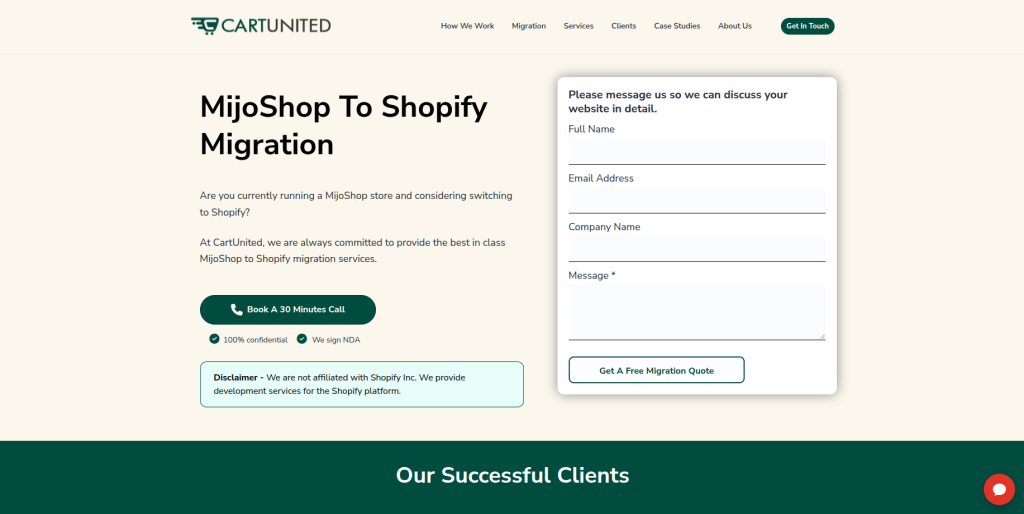
CartUnited is directly relevant to businesses planning a MijoShop To Shopify Migration because MijoShop is included among the ecommerce platforms it identifies for migration. Its migration approach covers areas such as content, assets, ecommerce data, SEO, redirects, and platform-specific requirements.
CartUnited’s Shopify migration capabilities can be useful for businesses that want to move their existing ecommerce operation while maintaining important elements of the existing store.
The migration can involve reviewing product information, customer data, order records, content, images, categories, URLs, and SEO requirements before the Shopify store is launched.
Businesses can explore the dedicated MijoShop to Shopify Migration service to understand the migration offering.
CartUnited also provides Shopify development and ecommerce migration services, making it suitable for projects where the migration is combined with design, performance, SEO, or functionality improvements. Its published Shopify migration portfolio includes migration, Shopify development, speed optimization, and SEO retention work.
Key capabilities:
- MijoShop to Shopify Migration
- Shopify migration
- Ecommerce migration
- Shopify development
- SEO retention
- Speed optimization
- Content migration
- Asset migration
- 301 redirects
- Ecommerce store optimization
2. EbizON
EbizON is a digital technology and ecommerce development company providing Shopify migration, Shopify development, ecommerce development, integrations, and custom solutions.
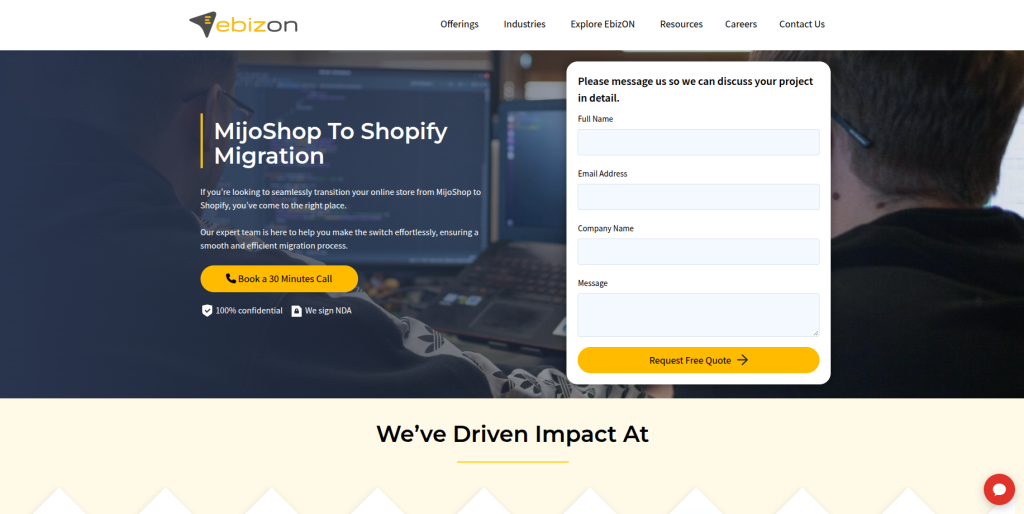
EbizON has a dedicated MijoShop To Shopify Migration service and describes a migration process covering products, custom fields, inventory, pricing, downloadable products, content pages, images, reviews, orders, taxes, coupons, customers, customer groups, and manufacturers.
The company also provides broader Shopify migration capabilities, including content migration, asset migration, categories and tags, SEO migration, 301 redirects, page-builder integration, plugin functionality replacement, responsive theme matching, custom Shopify theme development, CRM migration, and post-migration maintenance.
For businesses planning this specific platform transition, the dedicated MijoShop To Shopify Migration service provides information about the migration process and supported data.
EbizON’s Shopify capabilities can also be useful when a migration requires custom integrations, design changes, Shopify app development, SEO work, or ongoing store support.
Key capabilities:
- MijoShop To Shopify Migration
- Shopify migration
- Ecommerce development
- Shopify theme development
- Shopify app development
- Custom integrations
- SEO migration
- Data migration
- CRM integration
- Post-migration support
3. Website Development India
Website Development India is a web development-focused company that can be considered for website and ecommerce development requirements.
Businesses evaluating a MijoShop to Shopify migration may consider a web development provider when the project involves rebuilding the storefront, implementing ecommerce functionality, and connecting the new website with other business requirements.
For a migration project, the important areas to discuss would include product migration, customer information, order data, URL redirects, Shopify configuration, integrations, and testing.
The provider should be evaluated based on the exact Shopify migration requirements of the store, particularly where the project involves a large catalogue or custom MijoShop functionality.
Key areas to evaluate:
- Ecommerce website development
- Website development
- Shopify implementation
- Store customization
- Ecommerce functionality
- API and third-party integrations
- Website testing
4. Ranker Technologies
Ranker Technologies is a web development company offering website design and development services across platforms including Shopify, WordPress, BigCommerce, Wix, and Joomla.
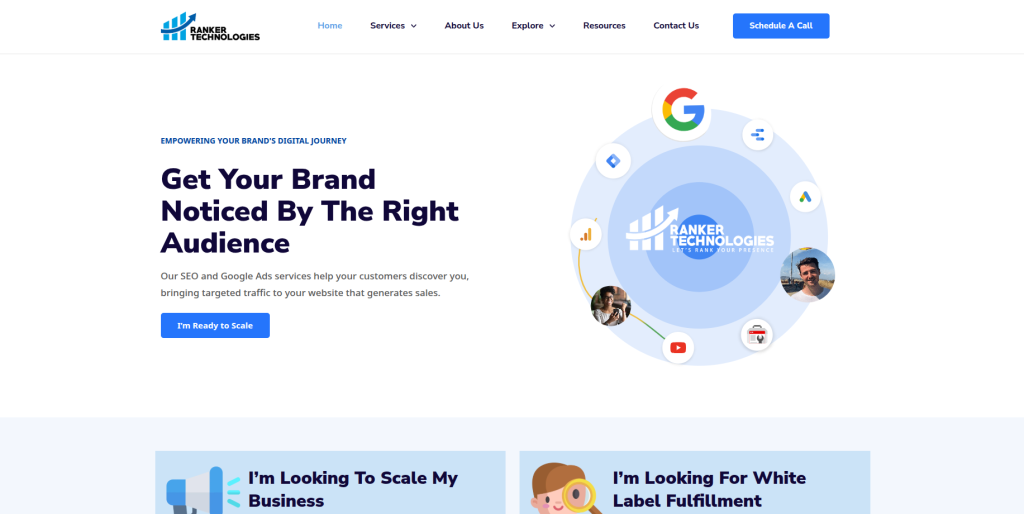
Its published web development offering specifically includes customized Shopify ecommerce stores focused on conversion and user engagement, alongside Joomla development and other web technologies.
This combination of Shopify and Joomla-related capabilities can be relevant when evaluating a migration from a MijoShop environment into Shopify.
For a MijoShop migration, the project would need to cover the existing ecommerce data, Shopify store configuration, design requirements, URL structure, redirects, and any functionality that needs to be rebuilt.
Key areas to evaluate:
- Shopify ecommerce development
- Joomla development
- Website design
- Store customization
- Conversion-focused design
- Ecommerce development
- Responsive websites
5. LiSquare Technologies
LiSquare Technologies is a technology and software development company that can be considered for web and ecommerce development projects.
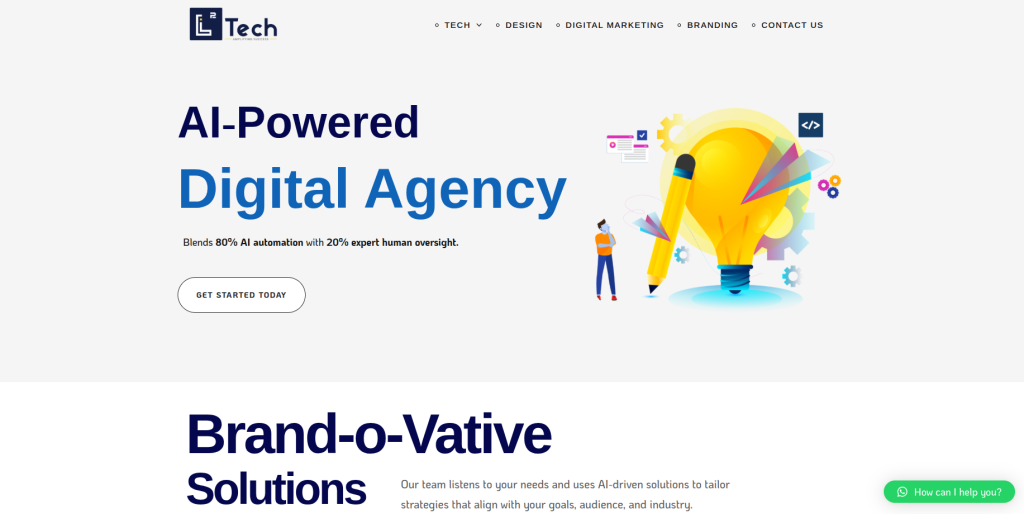
A business moving from MijoShop to Shopify may require more than a standard store setup, especially if the existing website includes custom functionality or integrations.
A development partner can help assess the existing website architecture, identify the functionality that needs to be reproduced, and determine how those requirements should be implemented in Shopify.
For this type of project, businesses should evaluate the provider’s specific Shopify migration experience, data migration process, integration capabilities, and post-launch support before engagement.
Key areas to evaluate:
- Web development
- Ecommerce development
- Shopify implementation
- Custom functionality
- API integrations
- Website redesign
- Technical support
6. WebLight IT Solutions
WebLight IT Solutions is a technology and web development provider that can be considered for ecommerce and website development requirements.
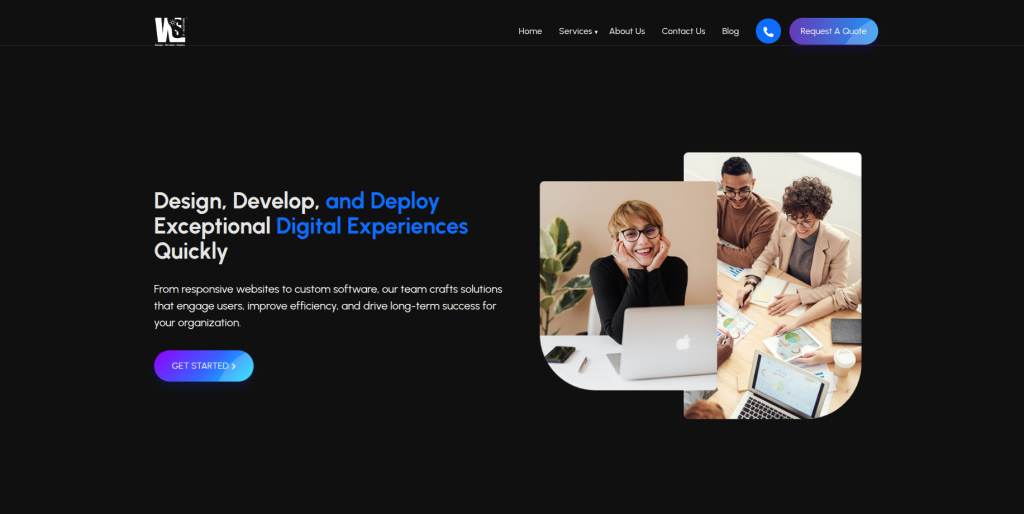
For a business planning a MijoShop To Shopify Migration, a technical development partner can be useful when the existing store contains custom functionality that cannot simply be transferred through a standard import.
The migration project should begin with an audit of the existing store, followed by product and customer data mapping, URL planning, Shopify configuration, integration work, testing, and launch preparation.
Businesses should assess the provider’s experience with Shopify, ecommerce migrations, custom integrations, and SEO preservation when comparing it with other migration companies.
Key areas to evaluate:
- Ecommerce development
- Web development
- Shopify store development
- Custom integrations
- Website optimization
- Responsive design
- Technical support
7. Social Benchers
Social Benchers is a digital development provider with experience creating online and ecommerce-focused digital experiences.

Its published work includes an ecommerce-oriented NationBuilder theme, with features such as product categorization, product imagery, shopping functionality, and checkout-related capabilities.
For a business moving from MijoShop to Shopify, a provider with ecommerce experience can be relevant when the project involves rebuilding the storefront and improving the customer-facing experience.
The migration requirements should be clearly defined before engagement, particularly around Shopify development, product data, customer records, historical orders, SEO, and integrations.
Key areas to evaluate:
- Ecommerce development
- Online store experiences
- Website development
- Custom digital experiences
- Ecommerce functionality
- User experience
- Store customization
8. JTek Software
JTek Software is a software development provider offering web development, mobile applications, ecommerce development, AI and ML services, dedicated developers, and QA testing.
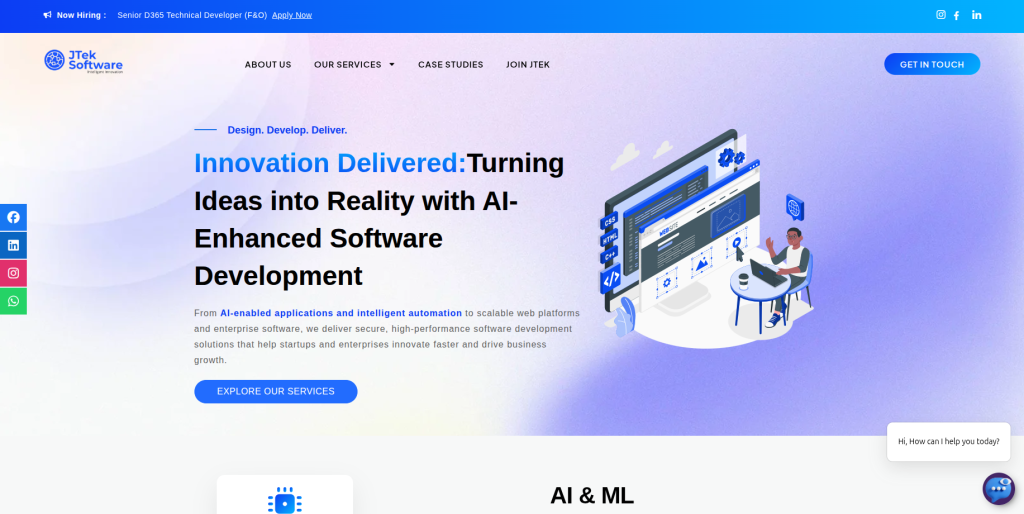
JTek’s published services include ecommerce development and web design and development, with a broader focus on application development, systems integration, solution delivery, and testing.
This technical background can be useful for ecommerce projects involving custom functionality, integrations, application-level requirements, or extensive testing.
For a MijoShop to Shopify migration, businesses should establish how the existing ecommerce functionality will be mapped into Shopify and which integrations or custom features need to be recreated.
Key areas to evaluate:
- Ecommerce development
- Web development
- Application development
- Systems integration
- QA and testing
- Custom development
- Dedicated development resources
9. Teksolto
Teksolto is a software development company working across web, mobile, ecommerce, and business application development.
Its company material highlights experience with development methodologies, usability and UX, ecommerce applications, retail, inventory, and business applications.
For businesses migrating an established MijoShop store, these capabilities can be relevant where the project involves more than storefront development and includes inventory, business processes, integrations, or custom application requirements.
The migration scope should clearly identify the data that needs to be transferred and the Shopify functionality required after launch.
Key areas to evaluate:
- Ecommerce applications
- Web development
- UX and usability
- Retail solutions
- Inventory-related applications
- Business applications
- Custom development
10. Jiffy Softwares
Jiffy Softwares is a web development company offering responsive websites, ecommerce integration, CMS integration, web applications, and SEO-focused website development.
Its website development service covers responsive design, SEO optimization, ecommerce integration, CMS integration, and web application development, with a development process that includes discovery, requirements, UI/UX, frontend and backend development, integrations, QA, deployment, and support.
These capabilities can be relevant for businesses that want to rebuild or modernize their ecommerce storefront during a platform migration.
For a MijoShop to Shopify project, businesses should discuss the exact Shopify requirements, data migration approach, URL redirects, integrations, testing, and post-launch support.
Key areas to evaluate:
- Ecommerce integration
- Website development
- Responsive design
- SEO optimization
- CMS integration
- Web application development
- API integrations
- QA and deployment
How to Choose the Right MijoShop To Shopify Migration Company
Selecting a migration company should be based on the technical requirements of the store rather than simply choosing a company that offers Shopify development.
1. Check Migration Experience
Ask whether the company has experience working with:
- MijoShop
- Shopify
- Joomla
- Ecommerce migrations
- Large product catalogues
- Customer data
- Historical orders
Experience with the actual source and destination platforms can make the migration easier to plan.
2. Review the Data Migration Process
Before starting the project, ask how the company will handle:
- Products
- Product variations
- Categories
- Images
- Customers
- Orders
- Reviews
- Coupons
- Inventory
- Custom fields
A detailed mapping plan can help reduce missing or incorrectly structured data.
3. Understand How Custom Features Will Be Rebuilt
MijoShop stores may contain custom functionality that does not have a direct Shopify equivalent.
The migration team should identify which features need to be:
- Rebuilt
- Replaced with Shopify apps
- Connected through APIs
- Customized through Shopify development
- Removed because they are no longer required
4. Ask About SEO Migration
The migration provider should have a clear process for:
- URL mapping
- 301 redirects
- Metadata
- Canonical URLs
- Internal links
- XML sitemap
- Search Console
- Indexation monitoring
SEO should not be left until after the Shopify store goes live.
5. Review Shopify Design and Development Capabilities
A migration is also an opportunity to improve the storefront.
Ask whether the company can handle:
- Shopify theme customization
- Custom theme development
- Mobile optimization
- Product page design
- Navigation
- Checkout experience
- Conversion optimization
- Shopify app integrations
6. Check Testing Procedures
Before launch, the migration team should test:
- Product pages
- Product variations
- Categories
- Search
- Cart
- Checkout
- Payments
- Shipping
- Taxes
- Customer accounts
- Coupons
- Order processing
- Mobile responsiveness
- Redirects
7. Ask About Post-Launch Support
Migration does not necessarily end when the Shopify store goes live.
Post-launch support can include:
- Bug fixes
- Shopify configuration
- App updates
- Performance monitoring
- SEO monitoring
- Analytics verification
- Integration support
- Store maintenance
Benefits of Moving From MijoShop to Shopify
Hosted Ecommerce Environment
Shopify provides a hosted environment, reducing the need for businesses to manage the underlying ecommerce server infrastructure themselves.
Easier Store Management
Shopify provides a centralized administration environment for managing products, orders, customers, discounts, themes, apps, and other store functions.
Shopify App Ecosystem
Businesses can extend their stores through Shopify apps for marketing, customer service, reviews, shipping, analytics, inventory, loyalty, and other functions.
Flexible Store Design
Shopify themes can be customized to create a storefront aligned with the company’s branding and customer experience requirements.
Ecommerce Integrations
A Shopify store can be connected with different business and marketing systems through apps, APIs, and integrations.
Opportunity for Store Optimization
A migration provides an opportunity to review:
- Site navigation
- Product organization
- Mobile experience
- Page speed
- Checkout
- Search functionality
- SEO
- Analytics
- Conversion paths
MijoShop To Shopify Migration Checklist
Before Migration
- Audit the existing MijoShop store
- Back up the existing website
- Export product data
- Export customer information
- Review order history
- Document existing URLs
- Identify custom functionality
- Record third-party integrations
- Review existing SEO settings
- Identify important landing pages
Migration Planning
- Define Shopify store architecture
- Map MijoShop data to Shopify
- Plan product and collection structure
- Decide how custom functionality will be rebuilt
- Select required Shopify apps
- Create URL mapping
- Prepare redirect rules
- Plan SEO migration
- Define testing requirements
Shopify Development
- Configure Shopify
- Select or develop the theme
- Create product structure
- Configure collections
- Configure navigation
- Set up payment methods
- Configure shipping
- Configure taxes
- Configure customer accounts
- Connect required apps
- Implement custom functionality
Data Migration
- Transfer products
- Transfer product images
- Transfer variations
- Transfer categories into the new structure
- Transfer customer information
- Transfer historical orders where required
- Transfer reviews
- Transfer coupons where applicable
- Validate inventory
- Check product URLs
- Verify migrated data
SEO Migration
- Crawl the existing website
- Map old URLs to new Shopify URLs
- Implement 301 redirects
- Transfer page titles
- Transfer meta descriptions
- Review headings
- Review canonical URLs
- Check internal links
- Generate the Shopify sitemap
- Verify Google Search Console
- Monitor indexing
Testing
- Test product pages
- Test collections
- Test product variants
- Test search
- Test cart
- Test checkout
- Test payment methods
- Test shipping
- Test taxes
- Test customer accounts
- Test discount codes
- Test order processing
- Test mobile layouts
- Test redirects
- Test analytics
Launch
- Take the final backup
- Complete the final data synchronization
- Verify the Shopify domain
- Check SSL
- Test critical pages
- Test redirects
- Submit or verify the sitemap
- Verify Search Console
- Verify analytics
- Monitor traffic and conversions
- Review crawl errors
Frequently Asked Questions
What is MijoShop To Shopify Migration?
MijoShop To Shopify Migration is the process of moving an ecommerce store from MijoShop to Shopify while transferring the required store data, content, products, customers, orders, media, and functionality.
Can MijoShop products be migrated to Shopify?
Yes. Product information can be migrated to Shopify, although the exact process depends on the existing data structure. Products, descriptions, images, pricing, inventory, variations, and custom fields may require mapping before import.
Can customer data be moved from MijoShop to Shopify?
Customer information can be migrated when the required source data is available and can be correctly mapped to Shopify’s customer structure.
Can historical orders be migrated?
Historical orders can be migrated depending on the source data, Shopify requirements, and the migration method used. The migration plan should establish which order information needs to be retained.
Will my MijoShop URLs change after moving to Shopify?
They may. Shopify can use a different URL structure from the existing MijoShop store. Old URLs should therefore be mapped to the appropriate Shopify URLs and redirected where necessary.
Will MijoShop to Shopify Migration affect SEO?
It can if URLs, metadata, redirects, content, internal links, or indexation are handled incorrectly. A dedicated SEO migration plan can help reduce the risk of losing organic visibility.
Can I keep my existing website design?
The existing design can often be recreated or adapted within a Shopify theme. However, some MijoShop-specific functionality may need to be redesigned or rebuilt using Shopify-compatible functionality.
What happens to MijoShop extensions?
Each extension should be evaluated separately. Some functionality may be replaced by Shopify apps, while custom functionality may require Shopify development or API-based integrations.
How long does a MijoShop To Shopify Migration take?
The timeline depends on the size and complexity of the store. Product volume, customer records, order history, custom functionality, integrations, design requirements, SEO work, and testing can all affect the project duration.
Should I redesign my store during the migration?
Not necessarily, but migration can be a good opportunity to improve navigation, mobile usability, product pages, page speed, and the overall shopping experience.
What should be tested before launching the Shopify store?
At minimum, businesses should test products, collections, search, cart, checkout, payments, shipping, customer accounts, discounts, orders, redirects, mobile layouts, analytics, and important integrations.
Conclusion
A MijoShop To Shopify Migration is an opportunity to move an established ecommerce business into a modern hosted Shopify environment while reviewing the store’s data, design, SEO, functionality, and customer experience.
The migration should go beyond transferring products. Businesses should plan for products, customers, orders, categories, images, content, URLs, redirects, SEO, integrations, payments, shipping, and testing.
Among the companies reviewed, CartUnited and EbizON are the most directly aligned with this specific migration requirement, with both providing dedicated MijoShop-to-Shopify migration services. CartUnited’s broader migration offering includes MijoShop among its supported source platforms, while EbizON provides a dedicated MijoShop-to-Shopify service with detailed migration coverage.
The remaining companies offer various combinations of ecommerce development, Shopify development, web development, software development, UX, integrations, and testing. Their suitability will depend on the complexity of the individual migration and the specific functionality that needs to be transferred.
The best migration partner should be able to create a clear plan for data migration, Shopify development, URL redirects, SEO preservation, integrations, testing, launch, and post-migration support so the business can move platforms without unnecessarily disrupting its customers or online presence.