
Top 10 BASE To Shopify Migration Companies
Moving an online store from one platform to another can feel like moving a busy shop while customers are still walking through the door. Your products, customers, orders, images, URLs, and store settings all need to reach the new platform safely.
That is why choosing the right BASE To Shopify Migration company matters.
Shopify’s official migration guide recommends reviewing the content and data you want to move before starting. This can include products, customers, historical orders, gift cards, blogs, and pages. Shopify also recommends checking products after import, configuring shipping, taxes, and payments, testing orders, setting up the domain, and reviewing SEO before launch.
This guide compares 10 BASE To Shopify Migration Companies in 2026, including CartUnited and EbizON plus the eight companies you provided. The goal is to help you build a shortlist based on migration planning, Shopify skills, data handling, SEO, design, testing, and post-launch support.
For companies where direct BASE-to-Shopify migration experience is not clearly documented publicly, we recommend verifying that experience before hiring.
Best BASE To Shopify Migration Companies in 2026
Here are the companies covered in this comparison:
- CartUnited
- EbizON
- Underscore Design
- US Websites
- ZU Media
- ExtremHex
- AB Advisoring
- Tutto Siti Web
- Refresh Perspective
- Bilal Web Studio
Competitor company names are intentionally not linked. Before choosing any provider, ask for recent Shopify migration examples and proof of experience with a store similar to yours.
How We Selected These BASE To Shopify Migration Companies
A good migration partner should understand that moving a store is about more than copying products. Shopify itself notes that migration can involve products, customers, historical orders, pages, blogs, and other business data. The migration method can range from CSV files and migration apps to hiring a Shopify Partner or creating a custom solution with Shopify APIs.
We recommend comparing companies around these areas:
- BASE store data handling: Products, variants, customers, orders, images, and other important records.
- Shopify development: Theme setup, apps, custom features, collections, payments, and shipping.
- SEO migration: URL mapping, redirects, metadata, internal links, and important landing pages.
- Migration testing: Product checks, checkout tests, mobile testing, payments, shipping, and analytics.
- Post-launch support: Fixing migration problems and helping the Shopify store settle after launch.
1. CartUnited
Best for Structured BASE to Shopify Migration and Complete Store Data Transfer
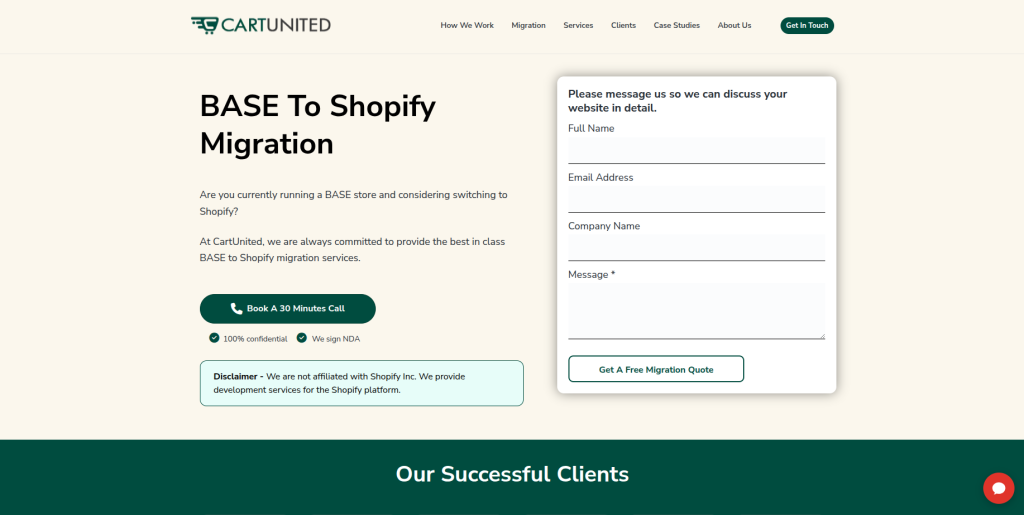
CartUnited is a strong option for businesses that want a focused move from BASE to Shopify. A migration can include products, variants, categories, images, customer information, order data, URLs, content, and other important store information. The team should first understand how the existing BASE store works and then map that information into Shopify correctly. This is especially useful for businesses that want migration support without turning the project into an unnecessarily large digital transformation. Shopify setup, testing, redirects, and launch planning should all be considered part of the wider migration process.
- BASE store migration: Focuses on moving an existing ecommerce store into Shopify.
- Product data planning: Products, variants, SKUs, prices, images, and categories can be mapped before migration.
- Shopify store setup: The new environment can be prepared around the needs of the existing business.
- SEO migration planning: Important URLs and organic landing pages can be considered before launch.
- Best suited for: Businesses seeking a structured BASE to Shopify store migration service.
Shopify also recommends reviewing and organizing imported products after migration, including descriptions, images, variants, prices, and meta descriptions. This makes careful data validation an important part of any store move.
For businesses that need a focused process from planning through launch, CartUnited provides a complete BASE to Shopify migration service for moving ecommerce store data safely.
2. EbizON
Best for BASE to Shopify Migration With Custom Development and Integrations
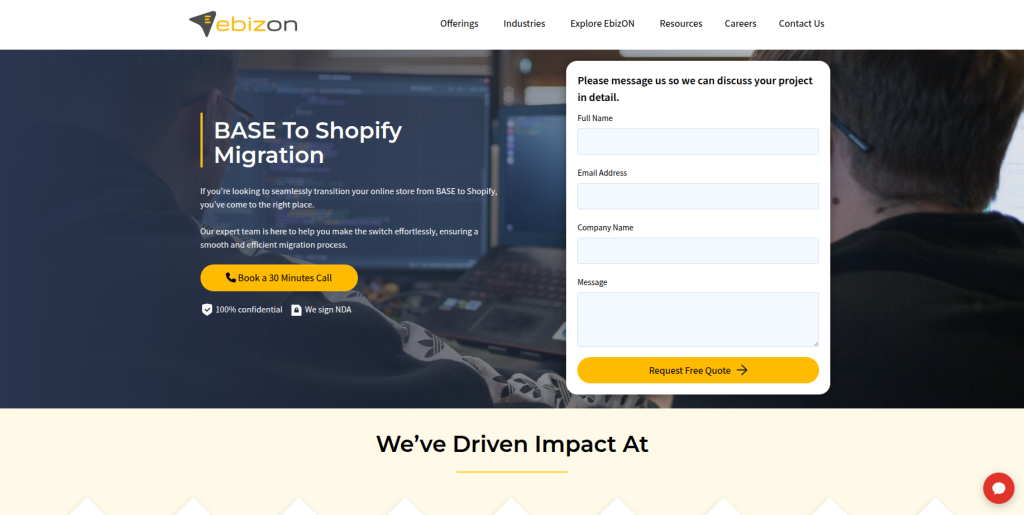
EbizON is worth considering when moving from BASE to Shopify involves more than transferring standard store data. Some businesses need a redesigned storefront, custom Shopify functionality, app configuration, third-party integrations, or changes to the buying journey at the same time. This makes a broader development approach useful for stores with more complicated requirements. The migration plan should separate what needs to be transferred, rebuilt, replaced, and improved. This can help keep the project controlled while still using the migration as an opportunity to build a stronger Shopify store.
- End-to-end migration: Suitable when data migration and Shopify development need to happen together.
- Custom Shopify development: Useful for stores that cannot replace existing BASE features with standard Shopify functionality.
- Integration support: Relevant for businesses connecting Shopify with marketing, ERP, CRM, inventory, or other systems.
- Store improvement: Migration can be combined with improvements to design, navigation, checkout, and customer experience.
- Best suited for: Growing businesses with custom BASE to Shopify migration and development requirements.
A store with complex requirements should discuss these needs before migration begins rather than discovering them near launch. Businesses looking for wider technical support can review EbizON’s BASE to Shopify migration solution for custom ecommerce stores and integrations.
3. Underscore Design
A Design-Led Option to Evaluate for BASE Store Migration to Shopify

Underscore Design is one of the companies worth evaluating when design and customer experience are important parts of your Shopify move. A platform migration can be a good time to review an old storefront and decide what should stay and what should change. However, strong design skills alone do not prove deep BASE migration experience. Businesses should therefore ask how product data, customers, orders, URLs, and integrations would be handled. Direct examples of Shopify migration work should carry more weight than general website portfolio examples.
- Store design: Consider when the new Shopify storefront also needs a visual update.
- Customer experience: Review its approach to navigation, product discovery, and mobile shopping.
- Shopify knowledge: Ask for recent Shopify stores with requirements similar to yours.
- Migration experience to verify: Request evidence of BASE or comparable ecommerce platform migrations.
- Best suited for: Businesses combining BASE to Shopify migration with storefront redesign.
4. US Websites
A Web Development Partner to Assess for Shopify Store Migration Projects
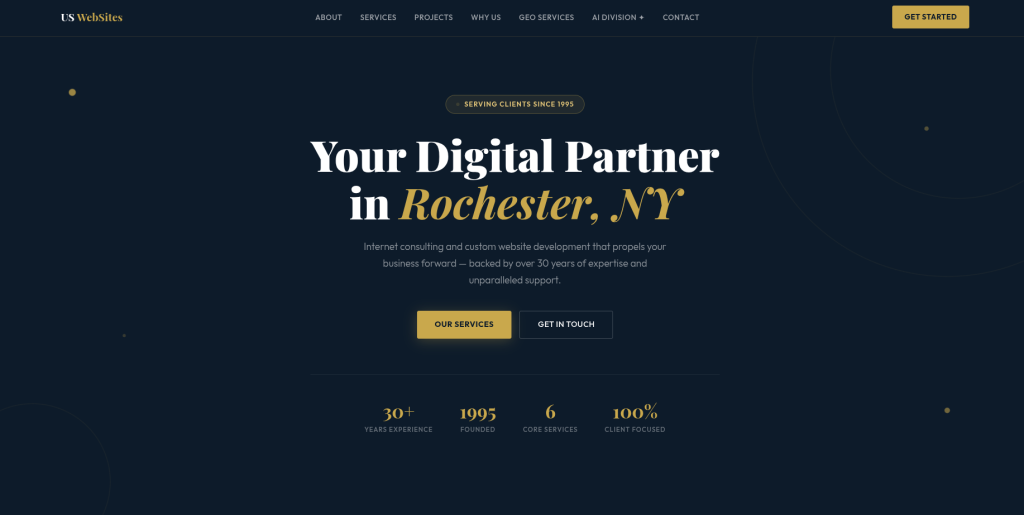
US Websites can be evaluated by businesses looking for website development support alongside a platform move. During a BASE migration, the development team may need to handle themes, content pages, product templates, apps, forms, tracking, and other storefront elements. Before hiring, ask the company to explain exactly how it would move BASE data into Shopify. A good answer should cover more than design and page building. It should also explain data validation, redirects, checkout testing, launch planning, and support after the new store goes live.
- Website development: Useful when migration also involves rebuilding or improving storefront pages.
- Shopify setup: Confirm experience with themes, collections, apps, payments, and shipping.
- Data handling: Ask how products, variants, customers, and orders would be transferred.
- Migration evidence: Request examples of ecommerce platform migrations rather than standard website projects.
- Best suited for: Businesses looking for web development support during a BASE to Shopify move.
5. ZU Media
A Digital Experience Option for BASE to Shopify Store Modernization

ZU Media can be considered when the move to Shopify is also part of a wider digital refresh. Businesses often use a platform migration to improve their product presentation, navigation, content, mobile experience, and brand messaging. These improvements can be valuable, but migration accuracy should remain the first priority. Ask how the company would protect existing product information and customer-facing URLs while building the new experience. BASE-specific and Shopify-specific migration examples should be checked before making a final decision.
- Digital experience: Relevant when migration is connected with a broader website improvement project.
- Store presentation: Consider its ability to improve product and category experiences.
- Mobile experience: Check how the new Shopify store would work across different screen sizes.
- Experience to verify: Ask for recent Shopify migrations and BASE-specific knowledge.
- Best suited for: Brands planning a BASE to Shopify migration with digital experience improvements.
Shopify’s migration checklist also recommends creating URL redirects when necessary so existing customers can reach the right content after a move. This is why design improvements should be planned alongside URL and SEO requirements rather than separately.
6. ExtremHex
A Technical Development Option to Review for Custom BASE to Shopify Migration
ExtremHex is another provider businesses can assess when their BASE store contains technical requirements beyond a basic catalog transfer. Custom features, integrations, product rules, or unusual workflows can make migration more complicated. The first step should be a technical review of what exists in the current store. The team should then explain which features can use Shopify’s standard capabilities, which require apps, and which may require custom development. Ask for comparable ecommerce migration examples before committing to the project.
- Technical discovery: The existing BASE environment should be reviewed before migration begins.
- Custom requirements: Useful to assess when standard Shopify features may not cover everything.
- Integration planning: Ask how external systems and business tools will connect after migration.
- Migration testing: Confirm the process for testing data, storefront functions, and checkout.
- Best suited for: Stores with custom technical requirements during a BASE to Shopify migration.
7. AB Advisoring
A Business-Focused Partner to Evaluate for Planned Shopify Migration

AB Advisoring can be considered by businesses that want to connect a platform move with wider business requirements. A good migration starts by understanding how the store actually works, including products, orders, customers, fulfillment, marketing, and reporting. This business view can help prevent important workflows from being forgotten during development. However, technical migration experience still needs to be checked carefully. Ask for direct Shopify work, migration examples, and a clear explanation of how BASE data would reach the new store.
- Business requirements: Useful for defining what the Shopify store needs to support after migration.
- Migration planning: Ask for a clear scope covering data, features, integrations, and launch.
- Shopify capability: Verify hands-on experience with real Shopify ecommerce projects.
- Technical experience to verify: Request BASE or similar platform migration examples.
- Best suited for: Businesses wanting a planned BASE to Shopify migration aligned with wider operations.
8. Tutto Siti Web
A Website Development Option for Small and Mid-Sized BASE Store Migrations
Tutto Siti Web is another company to consider when moving a small or mid-sized ecommerce website to a new platform. These projects still require careful planning even when the store does not have thousands of products. Product details, images, variants, URLs, customer information, and checkout settings all need attention. Businesses should ask how the company approaches Shopify data imports and how it checks the results after migration. Post-launch support should also be discussed before the project starts.
- Website development: Relevant for stores that need migration plus general website work.
- Store setup: Verify Shopify experience covering themes, products, collections, and apps.
- Data checks: Ask how imported products, images, variants, and other records are validated.
- SEO protection: Confirm how old URLs and redirects will be managed.
- Best suited for: Smaller businesses seeking BASE to Shopify migration and website development support.
Shopify supports CSV files for bulk product transfers, but its documentation warns that the source data must match Shopify’s required CSV structure and recommends backing up product data before an import.
9. Refresh Perspective
A Store Refresh Option to Assess During BASE to Shopify Replatforming
Refresh Perspective may be worth evaluating when a business wants its Shopify move to create a cleaner and more modern customer experience. Migration gives store owners a chance to review old pages, outdated content, weak navigation, and confusing customer journeys. Still, visual improvements should never come at the cost of missing products or broken URLs. Ask how migration work is separated from redesign work and how each stage is tested. Direct experience with Shopify and ecommerce replatforming should be verified before hiring.
- Store refresh: Relevant when an older BASE storefront needs a more modern appearance.
- User experience: Consider how navigation, product pages, and conversion paths can improve.
- Content review: Migration can be used to clean up outdated or low-value store content.
- Shopify experience to verify: Ask for migration projects with comparable store complexity.
- Best suited for: Brands combining BASE to Shopify replatforming with a customer experience refresh.
10. Bilal Web Studio
A Hands-On Development Option for Smaller BASE to Shopify Migration Projects
Bilal Web Studio can be evaluated by businesses that prefer a smaller, more hands-on development setup. This approach can work well when the project has a clear scope and direct communication is important. Even a smaller migration, however, can involve product data, customer records, images, URLs, theme setup, apps, payments, shipping, and testing. Make sure there is enough technical capacity to cover every part of the move. Businesses should also ask what support is available if problems appear after launch.
- Direct development support: Can suit businesses that prefer closer communication with the technical team.
- Shopify setup: Verify experience with themes, apps, collections, payments, and store configuration.
- Data migration: Ask how BASE products, customers, and other records would be transferred and checked.
- Post-launch coverage: Confirm who handles migration bugs and technical problems after launch.
- Best suited for: Smaller businesses seeking a hands-on BASE to Shopify migration development partner.
What Should Be Migrated From BASE to Shopify?
A proper BASE migration starts with an inventory of everything inside the current store.
Shopify recommends reviewing the existing store and deciding what content and data should move. Its migration documentation specifically identifies products, customers, historical orders, gift cards or store credits, blogs, and pages as examples of information businesses may want to migrate.
Your own checklist may include:
- Products and SKUs
- Product descriptions
- Product images
- Variants and options
- Prices
- Inventory
- Categories or collections
- Customer records
- Historical orders
- Reviews
- Discount information
- Content pages
- Blog content
- SEO metadata
- Important URLs
- Redirects
- Tracking codes
- Payment configuration
- Shipping rules
- Integrations
Not every piece of information will move in exactly the same format. This is why data mapping should happen before the final migration.
How Does BASE Work With Shopify?
One important point is that BASE and Shopify can also work together through an integration. Base.com’s own documentation describes connecting Shopify to Base so products, orders, inventory, and fulfillment-related information can move between the systems.
This creates an important question before you migrate:
Do you want to completely leave BASE, or do you want Shopify to become your storefront while BASE continues to support some backend operations?
The answer can change the entire technical plan.
If BASE still plays an important role in marketplace management, order processing, inventory, or fulfillment, your development team should review whether an integration makes more sense than removing BASE completely.
How to Choose the Best BASE To Shopify Migration Company
1. Check Their Shopify Migration Experience
Do not judge a provider only by how many websites appear in its portfolio.
Ask for projects where the team moved an existing ecommerce business from another platform to Shopify. Shopify itself warns partners that store migration can be complicated and that customer, product, and order records need to be imported correctly.
Ask each company:
- What platforms have you migrated to Shopify?
- Have you worked with BASE?
- How will you inspect our current store?
- How will data be mapped?
- How will you test imported information?
Clear answers are a good sign.
2. Make Sure They Understand Product Data
Product migration can become complicated when a catalog contains many variants, options, images, SKUs, or unusual fields.
Shopify allows products to be imported using CSV files, but the format must meet Shopify’s requirements. Its documentation also warns that changes to option values can create new variant IDs, which can affect third-party dependencies.
Your migration company should therefore test product data before performing the final import.
3. Protect Existing SEO
A new Shopify store should not casually throw away years of search visibility.
Make a list of important BASE URLs before launch. Map each old URL to its correct new destination. Shopify provides built-in tools for creating, importing, exporting, and managing URL redirects.
Your SEO migration checklist should cover:
- Product URLs
- Category URLs
- High-traffic pages
- Pages with backlinks
- Meta titles
- Meta descriptions
- Internal links
- Canonical signals
- XML sitemap
- Redirects
- Analytics
- Search Console
4. Ask About Customer and Order Migration
Products are only one part of your store.
Customer records and historical orders may also matter for support and business reporting. Shopify includes customers and historical orders among the types of information businesses can consider moving during migration.
Ask exactly which records can be transferred from your BASE setup and whether any information has limitations.
5. Test the New Shopify Store Before Launch
Never treat a successful data import as proof that the migration is complete.
Shopify’s migration checklist recommends testing the online store before launch, including successful and failed transactions, refunds, cancellations, fulfillment, and other store functions.
Your own testing should include:
- Product pages
- Variants
- Images
- Search
- Navigation
- Cart
- Checkout
- Payments
- Shipping
- Taxes
- Discounts
- Customer accounts
- Mobile layouts
- Emails
- Analytics
- Redirects
The goal is simple: customers should be able to shop without knowing how complicated the migration was behind the scenes.
Best BASE To Shopify Migration Company by Business Need
If you want a migration-focused option, CartUnited is a logical company to evaluate first.
If your migration also needs custom Shopify development, integrations, or broader ecommerce work, EbizON can be considered.
For the other eight companies in this comparison, match the provider to your requirements rather than simply choosing the biggest or cheapest option. A design-focused business may have very different needs from a store with custom integrations or a large product catalog.
Most importantly, ask every shortlisted company for evidence of relevant Shopify migration work.
FAQs
1. What is BASE To Shopify Migration?
BASE To Shopify Migration is the process of moving an ecommerce store or its storefront operations from BASE to Shopify. Depending on the store, the project can involve products, variants, customers, orders, images, content, URLs, SEO information, integrations, and store settings.
2. Which is the best BASE to Shopify migration company?
There is no single company that is best for every business. CartUnited is worth considering for a migration-focused project, while EbizON can be evaluated when migration also requires custom development and integrations. Compare providers based on your store size, data, custom features, SEO requirements, and support needs.
3. What data can be moved from BASE to Shopify?
The migration may include products, SKUs, descriptions, prices, images, variants, inventory, customers, historical orders, content, and other store information. What can be moved depends on your BASE setup and how the data maps into Shopify.
4. Can I keep BASE connected after moving my storefront to Shopify?
Potentially, yes. Base provides a Shopify integration that can support the movement of products, orders, inventory, and fulfillment-related information between the two systems. Your technical team should decide whether keeping BASE connected fits your operational needs.
5. Will a BASE to Shopify migration affect SEO?
It can if URLs, content, metadata, or internal links change without proper planning. Build a URL map before launch and create redirects for important old URLs that change. Shopify provides URL redirect management tools for this purpose.
6. Can product variants be migrated to Shopify?
Yes, but variants need to fit Shopify’s product structure. Complex product options should be reviewed carefully because incorrect mapping can create product or integration problems. Shopify’s product CSV documentation explains how product and variant information is structured for imports.
7. How long does BASE to Shopify migration take?
The timeline depends on the number of products, variants, customers, orders, integrations, custom features, design changes, and SEO requirements. A small store can be much simpler than a large store with custom workflows and years of historical information.
8. Should I redesign my store during the migration?
You can, but it adds another layer of work. A redesign makes sense when the existing BASE store is outdated or difficult to use. Keep migration accuracy as the first priority, and clearly separate essential migration tasks from optional design improvements.
9. What should be tested before launching Shopify?
Test products, variants, images, navigation, cart, checkout, payments, shipping, taxes, customer accounts, emails, mobile layouts, integrations, analytics, and redirects. Shopify’s own migration checklist recommends testing the store before opening it to customers.
10. How do I choose a BASE to Shopify migration partner?
Choose a provider that can explain its data migration process, Shopify experience, SEO plan, testing process, integrations, launch procedure, and post-launch support. Ask for relevant migration examples and make sure the company understands your BASE setup before accepting a final quote.
Conclusion
A BASE To Shopify Migration can give your business a new storefront and a chance to improve how customers shop, but the move needs careful planning.
Products, customers, orders, images, URLs, SEO signals, integrations, checkout, payments, and shipping can all be affected during migration. Shopify’s own guidance recommends reviewing the information you want to move, verifying imported products, configuring store settings, testing orders, setting up the domain, and reviewing SEO as part of the migration process.
For businesses looking for a focused BASE migration, CartUnited is a strong place to start. EbizON is also worth considering when the project requires wider Shopify development or custom integrations.
Whichever company you choose, ask for a clear migration scope before work begins. The best partner should be able to tell you what will move, what will change, how it will be tested, how SEO will be protected, and what happens after launch.
A successful migration should not simply put your old store on a new platform. It should give you a Shopify store that is easier to manage, easier for customers to use, and ready for the next stage of your ecommerce growth.