
Top 10 GoDaddy To Shopify Migration Companies
Moving an online store from GoDaddy to Shopify can give a growing business more room to sell, market, and manage products.
But a store migration is not just about copying products from one website to another.
Your products, images, customer details, pages, domain, URLs, SEO settings, payment setup, shipping rules, and tracking can all be affected during a GoDaddy To Shopify Migration.
That is why choosing the right migration company matters.
Shopify’s official guide for migrating an ecommerce store to Shopify includes GoDaddy among its supported migration guides. It recommends planning your data transfer, checking imported products, setting up shipping and payments, testing orders, connecting the domain, and reviewing SEO before and after launch.
In this guide, we look at the Top 10 GoDaddy To Shopify Migration Companies in 2026, including migration-focused companies and broader development providers that businesses can evaluate for their project.
Best GoDaddy To Shopify Migration Companies in 2026
The companies covered in this guide are:
- CartUnited
- EbizON Digital
- Creative Croods
- Nasha Tech
- Best IT Sol
- NUage Wireless
- GRSoft Solutions
- Vizability.io
- Regnia Software Consultancy
- Palsoro
CartUnited and EbizON Digital have been included for their direct relevance to the migration topic. The other companies should be evaluated against your exact GoDaddy store, Shopify requirements, data complexity, integrations, SEO needs, and required development work.
What Should a GoDaddy to Shopify Migration Include?
Before comparing companies, it helps to understand what actually needs to move.
Shopify says businesses may need to migrate products, customers, historical orders, gift cards, blogs, pages, and other store information. The right transfer method depends on the amount and complexity of the data.
For a GoDaddy store, your migration checklist may include:
- Products and product descriptions
- Product images and variants
- Customer information
- Historical order information
- Categories and Shopify collections
- Website pages
- Blog content
- SEO titles and descriptions
- Existing URLs and redirects
- Domain setup
- Payment gateways
- Shipping settings
- Taxes
- Analytics and marketing tracking
- Apps and integrations
Not every piece of information can always be moved in exactly the same format. That is why the migration company should audit your GoDaddy store before promising a final scope.
1. CartUnited
GoDaddy to Shopify Migration Services for Growing Online Stores
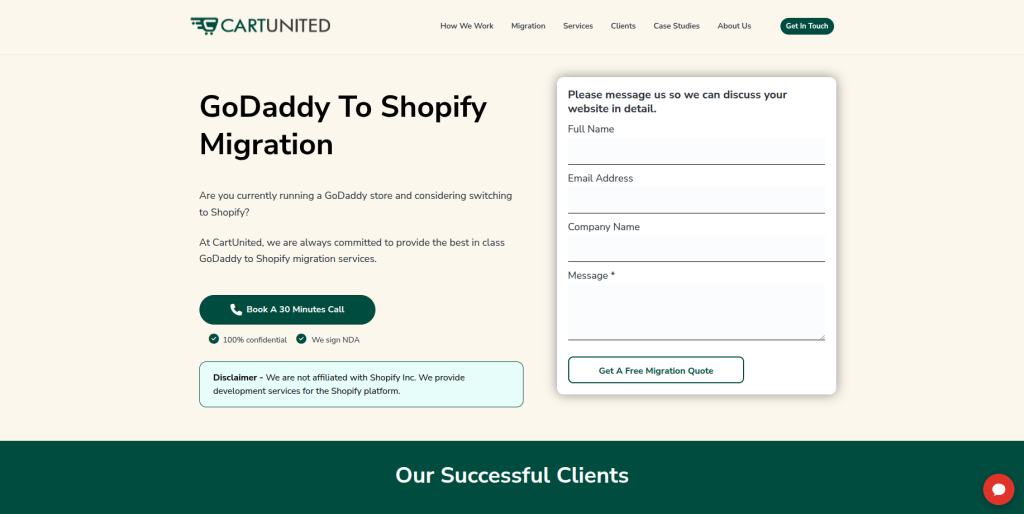
CartUnited is a strong option for businesses that want a migration-focused approach instead of treating the project like a normal website redesign. Moving from GoDaddy involves more than creating new Shopify pages. Products, images, collections, customers, URLs, content, and important store settings all need to be reviewed before launch. The migration also gives businesses a chance to clean old data and improve the structure of the new Shopify store. This makes CartUnited worth considering when the main goal is a structured move from an existing ecommerce platform to Shopify.
- Migration-focused approach: Suitable for businesses moving an existing ecommerce store to Shopify.
- Product data planning: Products, variants, images, descriptions, and related information can be reviewed before transfer.
- Shopify store setup: The new store can be prepared around the merchant’s products and selling requirements.
- SEO migration planning: Important GoDaddy URLs and organic landing pages should be mapped before launch.
- Best suited for: Businesses looking for a focused GoDaddy ecommerce store to Shopify migration partner.
Shopify also recommends deciding what content and data should move before starting a migration. Businesses that want professional help with that process can explore CartUnited’s complete GoDaddy ecommerce to Shopify migration service for growing online stores.
2. EbizON Digital
End-to-End GoDaddy Store Migration With Custom Shopify Development
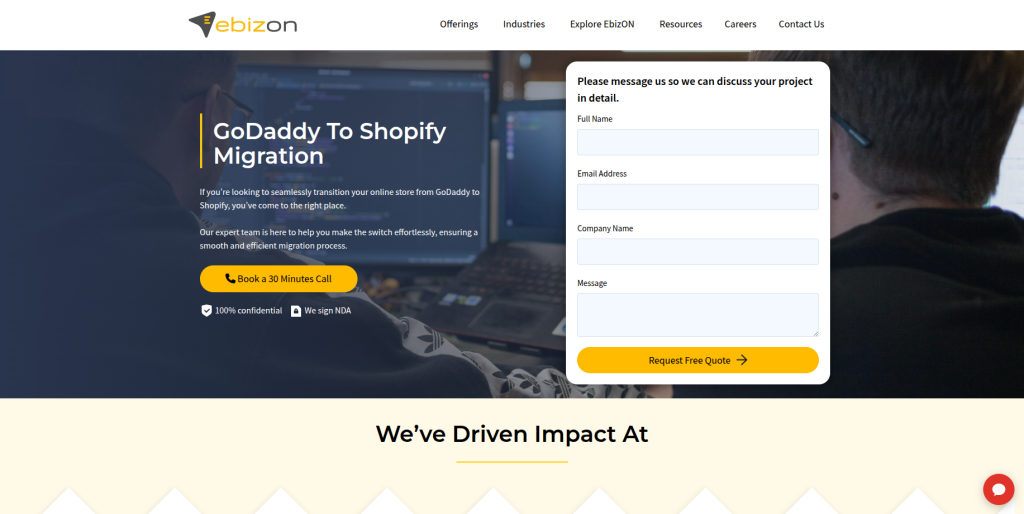
EbizON Digital is worth considering when the project involves both migration and broader Shopify development. Some GoDaddy stores need more than product transfer because the new Shopify site may also require a new theme, custom sections, integrations, checkout-related work, analytics, or changes to the shopping experience. In these cases, the migration team needs to understand the old store while also planning how the new one should work. This can make a broader ecommerce development approach useful for businesses with more complex requirements. The exact migration scope should still be agreed before development begins.
Businesses planning a more customized move can review EbizON Digital’s GoDaddy to Shopify migration and custom ecommerce development service to understand the type of migration support available.
- End-to-end migration: Useful when migration and Shopify development need to happen together.
- Custom development: Relevant when the new Shopify store needs functionality beyond a basic setup.
- Integration planning: Helpful for stores connected with marketing, payment, inventory, CRM, or other systems.
- Store experience: The migration can also be used to improve navigation, product pages, and customer journeys.
- Best suited for: Growing businesses with custom GoDaddy to Shopify migration requirements.
3. Creative Croods
Design-Led Support for GoDaddy Stores Moving to a New Shopify Experience
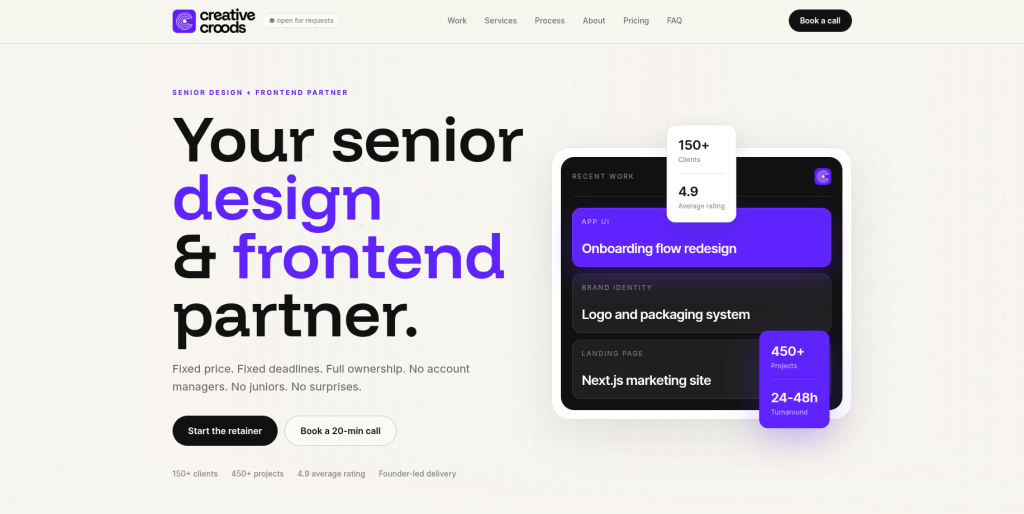
Creative Croods can be evaluated when visual design and customer experience are major parts of the migration project. Its public positioning focuses heavily on design, UI/UX, websites, product interfaces, and frontend development. The company also states that Shopify is not its usual platform, although it may recommend or work with Shopify when the project genuinely calls for it. That makes platform-specific verification especially important before choosing it for a GoDaddy migration. Businesses should confirm who will manage Shopify data transfer, store configuration, redirects, and platform-specific QA.
- Design expertise: Useful when the new Shopify store needs a major visual improvement.
- UI/UX focus: Relevant for improving product discovery and customer journeys.
- Frontend capability: Can support more customized digital experiences.
- Experience to verify: Ask specifically about recent Shopify migration projects and GoDaddy data handling.
- Best suited for: Brands combining GoDaddy store migration with a larger ecommerce redesign.
4. Nasha Tech
Technical Development Support for Complex Ecommerce Replatforming Projects

Nasha Tech positions itself as a software development company offering web systems, cloud development, mobile apps, UI/UX, legacy product re-engineering, and other technical services. Its public site also lists ecommerce among the industries in which it has worked. This broader technical background may be useful when a migration includes custom systems or development requirements beyond the storefront. However, businesses should verify direct Shopify and GoDaddy migration experience before hiring the company specifically for this task. A technical discovery call should make that fit much clearer.
- Web development: Relevant for projects that require more than a simple data import.
- Legacy modernization: Potentially useful when replacing older systems or workflows.
- UI/UX capabilities: Can support improvements to the new customer experience.
- Experience to verify: Request direct Shopify migration and GoDaddy ecommerce examples.
- Best suited for: Businesses with technical requirements around their ecommerce replatforming project.
5. Best IT Sol
Shopify Development Support for GoDaddy Ecommerce Store Migration

Best IT Sol is one of the companies on this list with publicly stated Shopify development services. Its website describes web development across platforms including WordPress, Shopify, and Laravel, while its Shopify offering is positioned around ecommerce store development. This gives businesses a clearer Shopify-related capability to investigate. Migration expertise should still be verified separately because developing a Shopify store and safely migrating an existing ecommerce business are not exactly the same task. Ask for examples that involved real product, customer, URL, and SEO migration work.
- Shopify development: Shopify is publicly included among the company’s web development platforms.
- Ecommerce focus: Relevant for building the destination store after leaving GoDaddy.
- Development support: Useful when the new store needs custom website work.
- Migration proof to request: Ask for examples involving data migration, redirects, and launch QA.
- Best suited for: Businesses seeking Shopify development alongside a GoDaddy store migration.
6. NUage Wireless
IT and Infrastructure Support for Businesses Planning an Ecommerce Platform Change
NUage Wireless is different from a traditional Shopify migration agency. Its public services focus mainly on managed IT, connectivity, cybersecurity, infrastructure, cloud services, professional services, and ongoing technology support. That wider IT background may be useful for businesses where an ecommerce platform move is connected to a larger technology project. However, its public website does not clearly establish specialist GoDaddy to Shopify migration services. Businesses considering NUage Wireless should therefore verify Shopify development and ecommerce migration capability directly before including it in a final shortlist.
- IT support: Relevant where migration is connected with broader technology requirements.
- Infrastructure knowledge: May help organizations dealing with several systems around their online operations.
- Ongoing support: The company’s positioning includes longer-term IT partnerships.
- Experience to verify: Confirm Shopify development and ecommerce data migration experience.
- Best suited for: Companies where ecommerce migration forms part of a wider IT project.
7. GRSoft Solutions
Ecommerce Development Support for Stores With Custom Technical Requirements

GRSoft Solutions provides web development, ecommerce portal development, application testing, custom software, and open-source development services. Its public technology list includes ecommerce platforms and WooCommerce, while the company also promotes application maintenance and legacy modernization. These capabilities can be relevant when moving away from an older ecommerce setup and rebuilding important business functions. However, Shopify is not clearly highlighted in the public material reviewed for this comparison. Direct GoDaddy to Shopify migration experience should therefore be confirmed before hiring.
- Ecommerce development: Publicly offers ecommerce portal development services.
- Custom software: Useful where the store connects with custom business applications.
- Testing capability: Relevant because migrated data and store functions need careful QA.
- Experience to verify: Request direct Shopify and GoDaddy migration examples.
- Best suited for: Businesses with custom development needs around an ecommerce platform migration.
8. Vizability.io
Ecommerce Website and Customer Experience Support for Store Modernization

Vizability.io positions itself around web design, marketing technology, ecommerce, online payments, apps, and business growth. Its website shows ecommerce as one of its digital experience areas and describes support around online selling and digital tools. This may make it useful for smaller businesses that want to combine a platform move with improvements to their website and customer experience. Direct GoDaddy to Shopify migration expertise is not clearly documented in the public material reviewed, so businesses should ask for relevant migration examples. Shopify-specific technical responsibilities should also be clearly defined before work starts.
- Ecommerce exposure: Publicly positions ecommerce among its digital capabilities.
- Website design: Useful when the new Shopify store also needs a visual refresh.
- Digital strategy: Relevant when migration is connected with broader online growth goals.
- Experience to verify: Ask for Shopify migrations involving real ecommerce data and redirects.
- Best suited for: Smaller businesses combining store migration with website modernization.
9. Regnia Software Consultancy
Custom Software Support for Integration-Heavy Ecommerce Migration Projects

Regnia Software Consultancy focuses publicly on software development and enterprise management systems. Its services include areas such as inventory management, purchasing workflows, invoicing automation, project management, and marketing systems. That type of business-system knowledge could become relevant if a Shopify store needs to work with operational software after migration. However, the public information reviewed does not establish the company as a dedicated Shopify or GoDaddy migration provider. Businesses should confirm Shopify experience, migration methodology, and integration capability for their exact environment.
- Enterprise systems: Relevant for businesses with operational software behind their store.
- Inventory workflows: Potentially useful when ecommerce products connect with inventory processes.
- Custom development: Can matter when standard Shopify functionality does not cover every requirement.
- Experience to verify: Confirm direct Shopify development and GoDaddy migration experience.
- Best suited for: Businesses considering an integration-heavy ecommerce replatforming project.
10. Palsoro
Digital Product Development for Businesses Rebuilding Their Online Experience
Palsoro describes itself as an end-to-end digital delivery company covering websites, custom software, apps, product design, AI, and automation. Its public site also shows work across digital products and business systems. That wider development capability may be useful if a GoDaddy migration is part of a larger digital project rather than a simple platform transfer. Direct GoDaddy to Shopify migration experience is not clearly established by the public information reviewed, so that should be verified before selection. Ask the team to explain exactly how it would handle Shopify data, redirects, testing, integrations, and launch.
- Web development: Suitable for broader website and digital development needs.
- Custom software: Relevant when ecommerce connects with internal business tools.
- UX and product design: Useful if the migration also changes the shopping experience.
- Experience to verify: Request Shopify migration examples and a detailed GoDaddy migration process.
- Best suited for: Businesses combining ecommerce migration with broader digital product development.
Why Businesses Move From GoDaddy to Shopify
GoDaddy can work well for businesses that want a straightforward website and online selling setup. But ecommerce needs often become more complicated as a business grows.
A merchant may eventually need better product organization, stronger ecommerce workflows, more apps, new sales channels, better inventory tools, advanced marketing integrations, or more control over the storefront.
This is where Shopify becomes attractive.
Shopify provides an ecommerce-focused environment for managing products, customers, orders, payments, shipping, themes, apps, and different sales channels from one platform.
Its official migration documentation also gives businesses several ways to move data. Depending on the type and amount of information, merchants can use manual methods, CSV files, migration apps, Shopify Partners, or custom solutions built with Shopify APIs.
What Data Can Be Moved From GoDaddy to Shopify?
The answer depends on how your GoDaddy store is configured.
A migration team should first create an inventory of everything that exists in the old store. This prevents important information from being discovered halfway through the project.
Common migration items include:
- Product names
- Product descriptions
- SKUs
- Prices
- Product images
- Variants
- Customers
- Historical orders
- Pages
- Blog posts
- SEO metadata
- Important URLs
- Domain settings
- Marketing and analytics configurations
Shopify’s official ecommerce migration checklist recommends reviewing migration tasks before configuring the new store and specifically calls attention to redirects and content migration.
The migration company should also explain which information cannot be transferred automatically and what will need to be recreated manually.
How to Protect SEO During a GoDaddy to Shopify Migration
SEO should be planned before the new Shopify store goes live.
GoDaddy and Shopify may use different URL structures. If an old product or page disappears without a redirect, customers following old links can reach a 404 page. Search engines can face the same problem.
Start by collecting your important GoDaddy URLs.
These may include:
- Product pages
- Category pages
- High-traffic pages
- Pages with backlinks
- Blog articles
- Landing pages
- About and contact pages
- Other pages receiving organic traffic
Map each important old URL to the closest matching page on Shopify.
Shopify provides an official guide to creating and managing Shopify URL redirects. Shopify also allows redirects to be imported using a CSV file, which can be useful when a store has many changed URLs.
After launch, test the old URLs and make sure they reach the correct new pages.
How to Choose a GoDaddy to Shopify Migration Company
A good-looking portfolio is useful, but it does not tell you whether a company can safely migrate your store.
Ask each provider the same questions.
1. Have You Migrated Ecommerce Stores to Shopify Before?
Ask for recent examples.
A company that designs websites may not automatically have experience migrating product catalogs, customer information, URLs, historical orders, and ecommerce settings.
The closer the example is to your own store, the better.
2. How Will You Move My Product Data?
Ask exactly how products will be transferred.
Shopify supports different migration methods depending on the data and complexity. Its official guidance includes manual transfers, CSV imports, migration apps, Shopify Partners, and custom API-based solutions.
Your provider should explain why its proposed method is suitable for your store.
3. How Will You Handle SEO and Redirects?
This should be answered before migration begins.
Ask how the company will identify important old URLs, map them to Shopify pages, implement redirects, transfer metadata, and test the new site.
Do not wait until launch day to start thinking about redirects.
4. Will You Test the New Shopify Store?
A successful import does not mean the migration is complete.
Products may have missing images. Variants may be wrong. Shipping rates may not work. Payment gateways may fail. Tracking can stop recording purchases.
Shopify recommends testing orders as part of its migration process. Your migration partner should also test products, collections, customer journeys, mobile layouts, redirects, forms, analytics, payments, and shipping before launch.
5. What Happens After Launch?
Ask how long the company provides migration support after the new store becomes live.
Post-launch checks should cover:
- 404 errors
- Redirects
- Orders
- Payments
- Product information
- Images
- Inventory
- Shipping
- Mobile usability
- Analytics
- Search visibility
- App conflicts
A clear support period makes it easier to deal with problems that appear only after real customers begin using the new store.
GoDaddy to Shopify Migration Checklist
Before approving your migration, make sure the project covers these areas:
- Back up important GoDaddy store information.
- List all products and product variants.
- Identify customers and historical orders that need migration.
- Review important website pages and content.
- Crawl or export existing URLs.
- Identify pages receiving organic traffic.
- Map old URLs to new Shopify URLs.
- Prepare Shopify products and collections.
- Configure shipping and taxes.
- Configure payment methods.
- Connect required apps.
- Test mobile and desktop layouts.
- Place test orders.
- Verify analytics and advertising tracking.
- Test redirects.
- Connect or transfer the domain.
- Submit the Shopify sitemap where required.
- Monitor the store after launch.
Shopify’s current migration guidance follows a similar sequence, starting with importing content and data, verifying products, configuring the store, testing orders, setting up the domain, and then checking SEO.
How Much Does GoDaddy to Shopify Migration Cost?
There is no single migration price that works for every store.
A small GoDaddy store with a few products and standard pages can be much easier to move than a large store with hundreds or thousands of products, customer history, custom functionality, integrations, and years of SEO traffic.
The cost normally depends on factors such as:
- Number of products
- Product variants
- Customer records
- Historical orders
- Number of pages
- Design requirements
- Custom functionality
- Third-party integrations
- SEO migration work
- Redirect volume
- Shopify theme customization
- Testing requirements
- Post-launch support
Ask for a detailed migration scope rather than comparing providers only by their starting price.
FAQs About GoDaddy To Shopify Migration
1. What is GoDaddy To Shopify Migration?
GoDaddy To Shopify Migration is the process of moving an ecommerce website from GoDaddy to Shopify. It can include products, images, customers, orders, pages, content, URLs, SEO information, domain settings, and other store data. The exact scope depends on the existing GoDaddy store.
2. Can I migrate my GoDaddy online store to Shopify?
Yes. Shopify specifically includes GoDaddy in its platform migration guidance. Depending on your store, information can be moved through manual transfer, CSV files, migration tools, Shopify Partners, or a custom migration solution.
3. Can products be moved from GoDaddy to Shopify?
Yes, product information can generally be migrated, but the method depends on your catalog. Product names, descriptions, images, SKUs, prices, and variants should all be checked after import to make sure the new Shopify catalog is accurate.
4. Can customer data be transferred from GoDaddy to Shopify?
Customer information may be transferred depending on what is available from the source store and the migration method being used. Shopify supports customer imports, but the migration team should first review the data structure and determine what can be transferred safely.
5. Will I lose SEO when moving from GoDaddy to Shopify?
A migration can affect SEO if URLs, content, metadata, internal links, or redirects are handled badly. Mapping important old URLs to relevant Shopify pages and testing redirects after launch can reduce this risk. SEO performance should also be monitored after migration.
6. Can I keep my existing domain after moving to Shopify?
Yes. An existing domain can generally be connected or transferred to Shopify. Shopify recommends preparing the domain carefully because the URL structure of the new store may differ from the old platform.
7. How long does a GoDaddy to Shopify migration take?
The timeline depends on the size and complexity of the store. A simple store may require much less work than a large catalog with customer history, custom features, integrations, SEO requirements, and a complete redesign. A proper audit is needed before setting a reliable timeline.
8. Should I redesign my store during migration?
You can. Migration is often a good time to improve an outdated design, but changing the platform, data, URLs, and design at the same time also adds complexity. Decide which improvements are necessary for launch and which can wait until after the migration.
9. What should I test after migrating from GoDaddy to Shopify?
Check products, variants, images, collections, customer information, navigation, redirects, mobile layouts, payments, shipping, taxes, forms, analytics, marketing pixels, apps, emails, and checkout. You should also place test orders before opening the store to customers.
10. How do I choose the right GoDaddy to Shopify migration company?
Look for relevant Shopify experience, a clear data migration process, SEO and redirect planning, strong QA, transparent project ownership, integration knowledge, and post-launch support. Ask each company to explain exactly how it would migrate your particular GoDaddy store rather than relying only on general ecommerce claims.
Conclusion
Moving from GoDaddy to Shopify can be a useful step when your ecommerce business needs more room to grow, more selling tools, stronger integrations, or a more flexible store experience.
The migration still needs careful planning.
Products need to arrive correctly. Images need to work. Customers and orders need to be handled properly. Important URLs need redirects. Payments and shipping need testing. Your domain needs to be connected correctly. Analytics and SEO also need attention.
The companies in this guide offer different types of support. Some are closer to ecommerce migration and Shopify development, while others bring broader design, software, IT, or digital experience capabilities.
Before choosing a provider, compare the team against your actual GoDaddy store and ask for evidence of relevant Shopify migration work.
A well-planned GoDaddy To Shopify Migration should not simply give you a new website. It should give your business a Shopify store that is accurate, easy to manage, ready for customers, and built for what comes next.